 Published by the Swedish Institute of Classical Studies in Rome. Distributed by Astrom Editions. Published with the aid of grants from the Swedish Council for Research in the Humanities and Social Sciences and the Norwegian Research Council
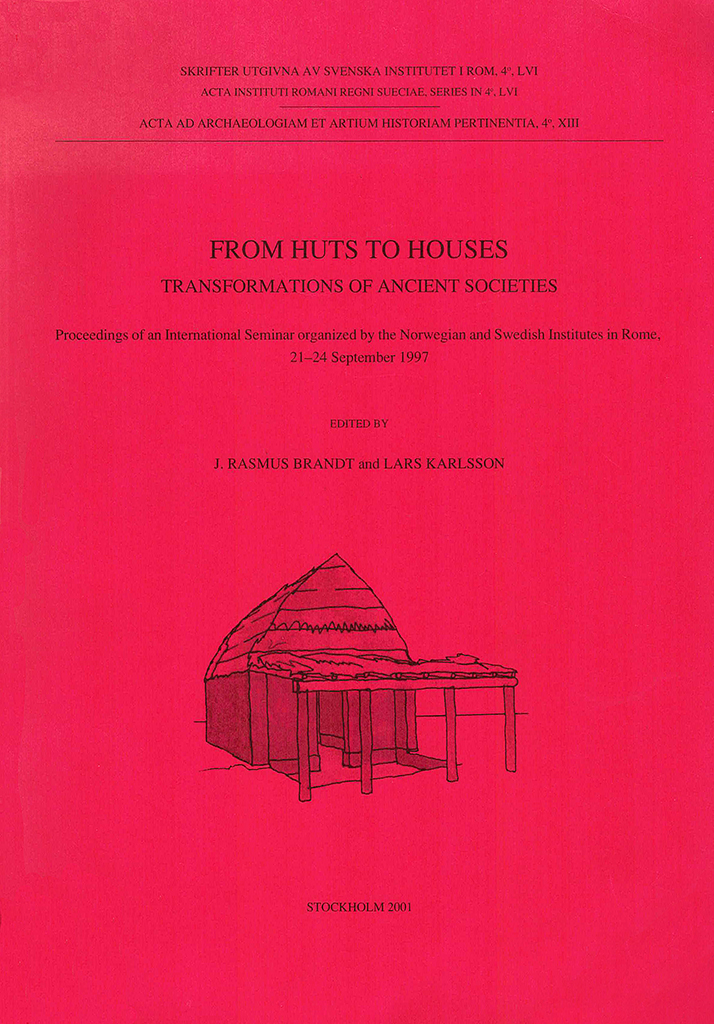
From huts to houses. Transformations of ancient societies. Proceedings of an international seminar organized by the Norwegian and Swedish Institutes in Rome, 21–24 September 1997
Edited by J. Rasmus Brandt & Lars Karlsson
Abstract
The present volume contains 43 of the 43 announced papers and 11 posters presented at an international conference in Rome in 1997. In a cross-cultural context, the papers examine various aspects of transformation processes connected with architectural changes, covering themes such as building types and development, building function, building technology, and finance and organization. Within this framework, the investigations span a long era, extending from the Mesolithic period to modern times, including experimental reconstructions of ancient dwellings. From the geographical and cultural point of view the contributions cover the Middle East and Europe from the Arabian deserts to the Arctic Ocean, though with a slight emphasis on central Italy in the Iron Age. The last article is a translation from Swedish to English of a study on shepherd huts in the Roman campagna made by S. Erixon in 1932, an article often quoted in studies on primitive architecture, but not easily accessible to all.
Contents
Rasmus Brandt & Lars Karlsson, ‘Introduction’, pp. 7–8
Building typology and development
Erhan Acar, ‘From hut to citadel: the evolution of housing and settlement in prehistoric Anatolia as changing patterns of space and time’, pp. 11–21
Eva Rystedt, ‘Huts vis-à-vis houses: a note on Acquarossa’, pp. 23–27
Alessandro Naso, ‘Dalla capanna alla casa: riflessi nell’architettura funeraria etrusca’, pp. 29–39
Vedia Izzet, ‘Putting the house in order: the development of Etruscan domestic architecture’, pp. 41–49
Lars Karlsson, ‘From hut to house: problems of restoring House 1 on the Acropolis of San Giovenale’, pp. 51–53
Gabriele Cifani, ‘Le origini dell’architettura in pietra a Roma’, pp. 55–61
Karl Reber, ‘Entwicklungsstufen in der Grundrissorganisation griechischer Wohnhäuser’, pp. 63–69
Jörgen Streiffert, ‘Prehistoric houses on the Swedish west coast’, pp. 71–72
Per Ole Rindel, ‘Building typology as a means of describing the development of early village communities in the 5th–3rd centuries B.C. at Grøntoft, Western Jutland, Denmark’, pp. 73–87
Wenche Helliksen, ‘Farms in transition: a study of settlement patterns in eastern Norway, 300 B.C. to A.D. 1200’, pp. 89–93
Eeva-Maria Viitanen, ‘Longhouses and log cabins: changing building traditions in the Late Iron Age and Early Medieval period (A.D. 800–1300) in Fennoscandia, pp. 95–100
Axel Christophersen, ‘The shaping of urban landscapes in medieval Norway: concepts and considerations’, pp. 101–108
Reidar Bertelsen, ‘Medieval civilization in Arctic earthen huts’, pp. 109–115
Barbro Santillo Frizell, ‘The dynamics of development in traditional house-building: ethnohistory and dry-masonry domes’, pp. 117–136
Building function
Alexander Mazarakis Ainian, ‘From huts to houses in Early Iron Age Greece’, pp. 139–161
Pontus Hellström, ‘Reflections on the function of the monumental building at Luni sul Mignone’, pp. 163–169
Laura Flusche, ‘Aristocratic architectural iconography at Poggio Civitate’, pp. 171–177
Demetrius J. Waarsenburg, ‘Living like a prince: the habitation counterpart of tombe principesche, as represented at Satricum’, pp. 179–188
Eero Jarva, ‘The functions of huts and houses with reference to the Latin settlement at Ficana’, pp. 189–194
Lil Gustafson, ‘The longhouse at Veien: a ‘central place’ in eastern Norway dating from the Roman Iron Age’, pp. 195–200
Building technology
Jochen Komber, ‘New aspects of the development of houses from the Mesolithic to the Viking period in northern Europe’, pp. 203–210
Anna Maria Bietti & Anna De Santis, ‘L’edificio della I età del Ferro di Fidene (Roma): posizione nell’abitato, tecnica costruttiva, funzionalità in base alla distribuzione spaziale dei materiali e degli arredi’, pp. 211–221
Olivier Büchsenschütz, ‘De la hutte à la maison, de Vitruve aux trois petits cochons’, pp. 223–231
Börje Blomé (†) & Carl Nylander, ‘On Etruscan earthquakes and architecture’, pp. 233–239
Börje Blomé (†), ‘A tentative reconstruction of House B on the Borgo of San Giovenale’, pp. 241–243
Helle Damgaard Andersen, ‘Thatched or tiled roofs from the Early Iron Age to the Archaic period in central Italy’, pp. 245–262
Helle Damgaard Andersen & Judith Toms, ‘The earliest tiles in Italy?’, pp. 263–268
Charlotte Wikander, ‘From huts to houses: the problem of architectural decoration’, pp. 269–272
Ola Storsletten, ‘From purlins to roof-trusses: transformations in ancient building technology’, pp. 273–282
Paolo Brocato & Francesco Gallucio, ‘Capanne moderne, tradizioni antiche’, pp. 283–309
Enrico Genovesi, ‘Laboratorio di architettura etrusca presso il Museo civico di Allumieri’, pp. 311–319
Organization and economy
Jacopo De Grossi Mazzorin, ‘Archeozoology and habitation models: from a subsistence to a productiove economy in central Italy’, pp. 323–330
Alberto Cazzella & Maurizio Moscoloni, ‘Non più villaggi, non ancora città: gli insediamenti dell’età del Bronzo dell’Italia sud-orientale’, pp. 331–336
Nuccia Negroni Catacchio & Laura Domanico, ‘L’abitato protourbano di Sorgenti della Nova: dagli spazi dell’abitare all’organizzazione sociale’, pp. 337–359
Gilda Bartoloni, ‘Evoluzione negli insediamenti capannicoli dell’Italia centrale tirrenica’, pp. 361–374
Valeria Acconcia, ‘Fosse e discariche come indizi di strutture sociali: alcuni esempi’, pp. 375–381
Anette Rathje & Iefke van Kampen, ‘The distribution of space and materials in domestic architecture in early Rome: a case study of the pre-Republican habitation levels on the Sepolcreto arcaico site at the Roman Forum’, pp. 383–388
Antonella Magagnini, ‘A case study of the evidence for pre-Republican habitation on the Velia hill, Rome’, pp. 389–394
Barbara Belelli Marchesini, ‘L’abitato costiero di Pyrgi: osservazioni sull’impianto urbanistico e sugli aspetti edilizi’, pp. 395–405
Rasmus Brandt, ‘From craftsman to specialist: the formation of occupations in Late Iron Age Latium’, pp. 407–413
Marianne Maaskant-Kleibrink & Peter Attema, ‘Pottery technology and the question of pre-urban and early urban transformations in southern Lazio’, pp. 415–425
Stephan G. Schmid, ‘The impact of pottery production on the sedentarization of the Nabataeans’, pp. 427–436
Nils-Axel Mörner, ‘Dowsing and radiation lines: the state of the art and its application to the San Giovenale site’, pp. 437–448
Appendix
Sigurd Erixon, ‘The shepherd huts in the Roman campagna and the characteristics of their construction’, pp. 451–458
‘Index of sites’, pp. 459–461
Bibliographical information
J. Rasmus Brandt & Lars Karlsson, eds, From huts to houses. Transformations of ancient societies. Proceedings of an international seminar organized by the Norwegian and Swedish Institutes in Rome, 21–24 September 1997 (Skrifter utgivna av Svenska institutet i Rom, 4°, 56), Stockholm 2001. ISSN 0081-993X. ISBN 9789170421631. Soft cover: 461 pages.
Reviews
Etruscan Studies 8:1, 2001, 164–167 (Michael L. Thomas).
L’antiquité classique 73, 2004, 565–566 (G. Raepsaet).
No Comments
Comments are closed.