Published by the Swedish Institute at Athens. Distributed by Astrom Editions. Opuscula Atheniensia. Annual of the Swedish Institute at Athens 29, 2004 Contents Katie Demakopoulou, Nicoletta Divari-Valakou, Ann-Louise Schallin, Erika Weiberg, Lena Sjögren & Monica Nilsson, ‘Excavations in Midea 2003’, pp. 9–27. Izabella Donkow, ‘A Hellenistic wreathed male head from Cyprus in the Museum of Mediterranean and Near Eastern Antiquities in Stockholm’, pp. 29–38. Niklas Hillbom, ‘The Knossos game board’, pp. 39–71. Isabelle Ratinaud-Lachkar, ‘Insoumise Asiné? Pour une mise en perspective des sources littéraires et archéologiques relatives à la destruction d’Asiné par Argos en 715 avant notre ère’, pp. 73–88. Book reviews Søren Dietz, ‘Review of M. Lindblom, Marks and makers. Appearance, distribution and function of Middle and Late Helladic manufacturers’ marks on Aeginetan pottery’, pp. 89–90. Carl Nylander, ‘Review of J. Boardman, Persia and the West: an archaeological investigation of the genesis of Achaemenid art’, pp. 90–92. Paavo Roos, ‘Review of P. Debord & E. Varinlioglu, eds, Les hautes terres de Carie’, pp. 92–94. Renée Forsell, ‘Review of S.E. Alcock, J.F. Cherry & J. Elsner, eds, Pausanias. Travel and memory in Roman Greece’, pp. 94–95. Jan Olof Rosenqvist, ‘Review of C. Mango, ed., The Oxford History of Byzantium’, pp. 95–97. ‘Books…
Published by the Swedish Institute of Classical Studies in Rome. Distributed by Astrom Editions. Pär Göran Gierow dedicata Opuscula Romana 20 Contents Kristina Berggren, Tre tombe a cremazione con trace di legno nella necropolis di Quattro Fontanili a Veio (Roma) Ingrid E.M. Edlund-Berry, The power of cults and sacred spaces. The interpretation romana of sanctuaries in southern Italy and Sicily Maria C. Eriksson, Two Etruscan mirrors in the Thorwaldsen Museum, Copenhagen Björn Forsén & Timo Sironen, Bolli laterizi romani nell’Antikmuseet in Göteborg Lena Landgren, The Roman pleasure garden—foundations for future studies Peter Liljenstolpe, De ornamentis templi Urbis. Reconstructing the main order of the temple of Venus and Roma in Rome Alessandro Naso, Osservazioni sull’origine dei tumuli monumentali nell’Italia centrale David Ridgway, Greek letters at Osteria dell’Osa Paavo Roos, Strabo and the water-mill at Cabeira. Some considerations Raffaele Santillo, Il «saxum ingentem» a Ravenna a copertura del Mausoleo di Teoderico: problemi e soluzioni Martin Söderlind, A central Italic, terracotta votive head in the Classical Museum of Antiquities in Lund (in association with Pierluigi Bianchetti, technical analysis) Margareta Strandberg Olofsson, Pottery from the monumental area at Acquarossa: a preliminary report Bengt E. Thomasson, Laterculi praesidium. Addendorum series altera Örjan Wikander, Senators and equites….
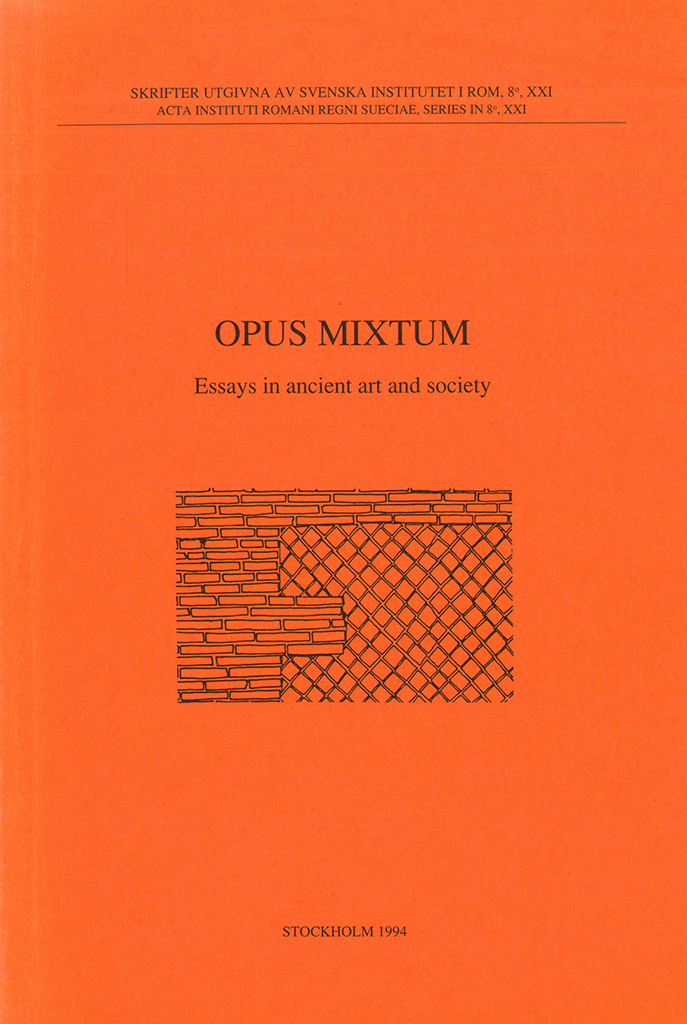
Published by the Swedish Institute of Classical Studies in Rome. Distributed by Astrom Editions. Opus Mixtum. Essays in ancient art and society Edited by Eva Rystedt, Charlotte Scheffer and Charlotte Wikander Abstract Fifteen papers on various aspects of ancient art and society are gathered in this volume. They deal with the choice of moment depicted in the Parthenon frieze, the use of the Greek architectural orders in political propaganda, and the “programme” of the relief plaques from zone F at Acquarossa which is suggested to be celebrations connected to the ruler. The architectural layout of a well-temple in Sardinia is interpreted as an iconographic message of the cult of Tanit-Astarte. The significance of the horse in connection with death and the various types of female deities connected with horses in Archaic Greek religion are discussed, as well as the image of Artemis Ephesia and its connection with the mysteries of the goddess, the epithet Ambologera (“Delayer of old age”) attributed to Aphrodite, and the role of women in Roman religion. A white-ground lekythos by the Achilles Painter with the “mistress-and-maid” motif associated with music-making is analysed. A reconstruction of the Laocoon group, especially regarding the positions of the serpents is…
Published by the Swedish Institute of Classical Studies in Rome. Distributed by Astrom Editions. Opuscula Romana 19 Contents Articles Carl Nylander, Gustavo VI Adolfo, il “re archeologo” S.M. Il Re Gustavo VI Adolfo, Discorso in occasione del conferimento della laurea ad honorem Oxford 1955 Olle Brandt, Recent research on the tomb of Eurysaces Peter Danner, Stützen im Giebel—Ein Motiv der etruskischen Wandmalerei Harry Erkell, L’Imperatore Commodo ed Ercole-Melcart Pamela Hemphill, The Romans and the San Giovenale area Bo Lawergren, Lyres in the West (Italy, Greece) and East (Egypt, the Near East), ca. 2000 to 400 B.C. Örjan Wikander, Senators and equites V. Ancestral pride and genealogical studies in Late Republican Rome Charlotte Wikander, Acquarossa: campagna di scavo 1991 The Swedish Institute in Rome. Report for the academic years 1990–91 and 1991–92 Book reviews Charlotte Wikander, review of R.R. Knoop, Antefixa Satricana. Sixth-century architectural terracottas from the sanctuary of Mater Matuta at Satricum (Le Ferriere) Örjan Wikander, review of O. Salomies, Die römischen Vornamen. Studien zur römischen Namengebung Örjan Wikander, review of I. Nielsen, Thermae et balnea. The architecture and cultural history of Roman public baths Örjan Wikander, review of G. Brodribb, Roman brick and tile Göran Bäärnhielm, review of B….
Published by the Swedish Institute at Athens. Distributed by Astrom Editions. Opuscula Atheniensia 19 Contents Carl Nylander, ‘Sture Brunnsåker, 1925–1978’, p. 9. Paul Åström, Katie Demakopoulou, Nicoletta Divari-Valakou & Peter M. Fischer, ‘Excavations in Midea, 1989–1990’, pp. 11–22. Gisela Walberg, ‘Excavations on the Lower Terraces at Midea’, pp. 23–39. Birgitta Bergquist, ‘A particular, Western Greek cult practice? The significance of stele-crowned, sacrificial deposits’, pp. 41–47. Mary Blomberg, ‘The meaning of Χελιδών in Hesiod’, pp. 49–57. Robin Hägg & Gullög C. Nordquist, ‘Excavations in the Levendis sector at Asine, 1989. A preliminary report with an appendix on the animal bones by Katrin Moberg’, pp. 59–68. Tullia Linders, ‘The Delian temple accounts: some observations’, pp. 69–73. Alexandros Mazarakis Ainian, ‘Nichoria in the south-western Peloponnese: Units VI-1 and IV-5 reconsidered’, pp. 75–84. Erik Østby, ‘Der dorische Tempel von Pherai’, pp. 85–113. Paul Rehak, ‘Minoan vessels with figure-eight shields: antecedents to the Knossos throneroom alabastra’, pp. 115–124. Eva Rystedt, ‘Notes on the rattle scenes on Attic Geometric pottery’, pp. 125–133. Berit Wells, ‘The walls of Asine’, pp. 135–142. Charlotte Wikander, ‘Pomp and circumstance. The procession of Ptolemaios II’, pp. 143–150. Örjan Wikander, ‘Archaic roof-tiles: the first (?) generation’, pp. 151–161. Miscellanea Åke Åkerström (†),…
Published by the Swedish Institute of Classical Studies in Rome. Distributed by Astrom Editions. Docto peregrino. Roman studies in honour of Torgil Magnusson Edited by Thomas Hall, Börje Magnusson & Carl Nylander Preface As Torgil Magnusson retires after more than thirty years as teacher and professor of Art History at the Swedish Institute in Rome, the Board of the Institute and his colleagues, students and friends—many of whom acquired their love of Renaissance and Baroque architecture and art from him—are happy to present him with this volume of Roman Studies. It is no small token of Torgil Magnusson’s contribution to Swedish art historical studies that his Festschrift introduces a new series of Art History publications from the Institute—a series which his scholarship and creative teaching have done so much to make possible. Roland Pålsson, Chairman of the Board of the Swedish Institute of Classical Studies in Rome Contents ‘Tabula gratulatoria’, pp. 6–11. Thomas Hall, ‘Torgil Magnusson—Doctus peregrinus’, pp. 12–19. Per Bjurström, ‘Queen Christina and contemporary art’, pp. 20–29. Börje Blomé, ‘Town planning—The debate in post-war Italy’, pp. 30–50. Hans Henrik Brummer, ‘”Among the shining antique marbles”. Victor Rydberg’s essays on Antinous’, pp. 51–77. Gerhard Eimer, ‘Simon Felice Delinos Macchina funerale…
Published by the Swedish Institute of Classical Studies in Rome. Distributed by Astrom Editions. Opuscula Romana 16 Contents Giovanni Colonna, ‘Il maestro dell’Ercole e delle Minerva. Nuova luce sull’attività dell’officina veiente’, pp. 7–41. Ingrid E.M. Edlund, ‘The sacred geography of southern Italy in Lycophron’s Alexandra’, pp. 43–49. Harry Erkell, ‘Varroniana III. Studi topografici. – Il culto all’Ara Maxima. Varro, De lingua latina V §§ 51–54 e VI § 54’, pp. 51–57. Erik J. Holmberg, ‘The Red-Line Painter’, pp. 59–90. Erik Nielsen, ‘Some preliminary thoughts on new and old terracottas’, pp. 91–119. Gad Rausing, ‘Charcoal, wheat and history’, pp. 121–124. Jocelyn Penny Small, ‘Left, right, and center: direction in Etruscan art’, pp. 125–135. Örjan Wikander, ‘Senators and equites. II. The aristocracy as agents of production’, pp. 137–145. Charlotte Wikander, Örjan Wikander & Giovanni Colonna, ‘An Etruscan inscription from Acquarossa’, pp. 147–148. Sebastian P.Q. Rahtz, ‘The Protestant Cemetery, Rome. A study undertaken under the auspices of the Unione Internazionale degli Instituti di Archeologia, Stora e Stora dell’arte in Roma. Interim report’, pp. 149–167. Carl Nylander, ‘The Swedish Institute in Rome (founded 1926). Report for the academic years 1984/85 and 1985/86’, pp. 169–171. ‘Guide for contributors to Opuscula Atheniensia and Opuscula Romana’, pp….
Published by the Swedish Institute of Classical Studies in Rome. Distributed by Astrom Editions. Opuscula Romana 14 Contents Pär Göran Gierow, ‘I colli Albani nel quadro della civiltà Laziale’, pp. 7–18. Carl Nylander, ‘The Standard of the Great King’, pp. 19–37. Ingrid Pohl, ‘Un capolavoro etrusco del tardo orientalizzante antico’, pp. 39–46. Thorkild Shøler & Örjan Wikander, ‘A Roman water-mill in the Baths of Caracalla’, pp. 47–64. Margaret Wadsworth, ‘A potter’s experience with the method of firing Bucchero’, pp. 65–68. Gregory Warden, ‘Bullae, Roman custom and Italic tradition’, pp. 69–75. Örjan Wikander, ‘An Etruscan inscription at Lund’, pp. 77–80. Örjan Wikander, ‘Skylight-tiles in the ancient world’, pp. 81–99. Leon Yarden, ‘Work in progress: The spoils of Jerusalem on the Arch of Titus. A reinvestigation’, pp. 101–102. Bibliographical information Opuscula Romana 14 (Skrifter utgivna av Svenska institutet i Rom, 4°, 39), Lund 1983. Softcover: 102 pp. ISSN 0081-993X. ISBN 9789170420856.
Published by the Swedish Institute at Athens. Distributed by Astrom Editions. Arne Furumark dedicata Opuscula Atheniensia 8 Contents Robert S. Merrillees, ‘Two Late Cypriote vases’, pp. 1–10. Homer L. Thomas, ‘Archaeological implications of Near Eastern historical chronology’, 11–22. V.E.G. Kenna, ‘Studies of birds on seals of the Aegean and Eastern Mediterranean in the Bronze Age’, pp. 23–38. Robin Hägg, ‘Mykenische Kultstatten im archaologischen Material’, pp. 39–60. Margareta Lindgren, ‘Two Linear B problems reconsidered from a methodological point of view’, pp. 61–76. Sture Brunnsåker, ‘LEOKORION = ra-wo-ko-ri-jo? A note on the toponymy of Athens’, pp. 77–86. Per Ålin, ‘Unpublished Mycenaean sherds from Asine’, pp. 87–105. Carl-Gustaf Styrenius, ‘A Submycenaean vase’, pp. 107–108. Frithiof Rundgren, ‘”Die leicht lebenden Götter”‘, pp. 109–110. Olivier Masson, ‘Notes de numismatique chypriote’, pp. 111–118. Carl Nylander, ‘ΑΣΣΥΡΙΑ ΓΡΑΜΜΑΤΑ. Remarks on the 21st letter of Themistokles’, pp. 119–136. T.B.L. Webster, ‘The Cesnola collection in Stanford’, pp. 137–148. Paavo Roos, ‘Research at Caunus’, pp. 149–166. Paul Åström, ‘Two inscriptions from Caunus’, pp. 167–169. Jonas Crampa, ‘Some remarks on Welles, Royal correspondence, 29’, pp. 171–178. Nils-Gustaf Gejvall & Folke Henschen, ‘Two Late Roman skeletons with malformation and close family relationship from ancient Corinth’, pp. 179–193. Paul Åström, Nils-Gustaf Gejvall & Per…
Published by the Swedish Institute of Classical Studies in Rome. Distributed by Astrom Editions and Eddy.se AB. San Giovenale. Results of excavations conducted by the Swedish Institute of Classical Studies at Rome and the Soprintendenza alle Antichità dell’Etruria Meridionale Vol. 1. Topographical introduction and history of excavations, photogrammatic methods and survey. Tombs Fasc. 1. Bengt E. Thomasson 1972. General introduction, Stockholm. ISSN 0081-993X. ISBN 9789170420078 (softcover: 12 pp.) Fasc. 2–3. Bertil Hallert 1967. Basics principles of photogrammetric methods used for measurements of San Giovenale & Bertil Hallert, Aerial photogrammetric survey of the San Giovenale area, Lund (softcover: 12 pp.) Fasc. 4. Carl Eric Östenberg 1972. The tombs: introduction, Stockholm. ISSN 0081-993X. ISBN: 9789170420085 (softcover: 16 pp.) Fasc. 5. Eric Berggren & Kristina Berggren 1972. The necropoleis of Porzarago, Grotte Tufarina and Montevangone. With drawings by Börje Blomé. With appendices by N.-G. Gejvall and Ruta Suksis-Jansson and with an addendum by Olof Vessberg, Stockholm. ISSN 0081-993X. ISBN 9789170420009 (softcover: 134 pp., 63 pls.) Fasc. 6. Carl Erik Östenberg & Olof Vessberg 1972. The necropolis at La Staffa, Stockholm. ISSN 0081-993X. ISBN 9789170420092 (softcover: 24 pp.) Fasc. 7. Carl Erik Östenberg 1969. The necropolis at Castellina Camerata, Lund (softcover: 29 pp.) Fasc. 8. Pär…