Opuscula is published by the Swedish Institutes at Athens and Rome, with the aid of a grant from the Swedish Research Council. Distributed by Eddy.se AB. View journal at ERIH PLUS. All content available with open access at the platform Publicera, hosted by the National Library of Sweden, use links below. Opuscula. Annual of the Swedish Institutes at Athens and Rome 5, 2012 Contents Articles Dancing with decorum. The eclectic usage of kalathiskos dancers and pyrrhic dancers in Roman visual culture By Julia Habetzeder, pp. 7–47, https://doi.org/10.30549/opathrom-05-02 Labraunda 2011. A preliminary report on the Swedish excavations Lars Karlsson, Jesper Blid, Olivier Henry & Ragnar Hedlund, pp. 49–87, https://doi.org/10.30549/opathrom-05-03 The New Swedish Cyprus Expedition 2011. Excavations at Hala Sultan Tekke. Preliminary results By Peter M. Fischer, Teresa Bürge, L. Franz & Rainer Feldbacher, pp. 89–112, https://doi.org/10.30549/opathrom-05-04 Euergetism and city-walls in the Italian city of Telesia By Richard Ramanius, pp. 113–122, https://doi.org/10.30549/opathrom-05-05 The water-mills on the Lamas River in Cilicia By Paavo Roos, pp. 123–131, https://doi.org/10.30549/opathrom-05-06 The impact of restoration. The example of the dancing satyr in the Uffizi By Julia Habetzeder, pp. 133–163, https://doi.org/10.30549/opathrom-05-07 The Swedish Jordan Expedition 2009 and 2010 at Tall Abu al-Kharaz. Preliminary results from the…
Opuscula is published by the Swedish Institutes at Athens and Rome, with the aid of a grant from the Swedish Research Council. Distributed by Eddy.se AB. View journal at ERIH PLUS. All content available with open access at the platform Publicera, hosted by the National Library of Sweden, use links below. Opuscula. Annual of the Swedish Institutes at Athens and Rome 4, 2011 Contents Articles A courtyard gate at Thourioi By Henrik Gerding, pp. 7–18, https://doi.org/10.30549/opathrom-04-02 Labraunda 2010. A preliminary report on the Swedish excavations By Lars Karlsson, Jesper Blid & Olivier Henry, pp. 19–67, https://doi.org/10.30549/opathrom-04-03 The New Swedish Cyprus Expedition 2010. Excavations at Dromolaxia Vizatzia/Hala Sultan Tekke. Preliminary results By Peter M. Fischer, P. Klingborg, F. Kärfve, F. Kärfve, C. Hagberg, O. Svensson, S. Macheridis & L. Franz, pp. 69–98, https://doi.org/10.30549/opathrom-04-04 Representing consulship. On the conception and meanings of the consular diptychs By Cecilia Olovsdotter, pp. 99–123, https://doi.org/10.30549/opathrom-04-05 Is it possible to believe in a syncretistic god? A discussion on conceptual and contextual aspects of Hellenistic syncretism By Petra Pakkanen, pp. 125–141, https://doi.org/10.30549/opathrom-04-06 Italian dreams, Roman longings. Vilhelm Lundström and the first Swedish philological-archaeological course in Rome, 1909 By Anna Holst Blennow & Frederick Whitling, pp. 143–158, https://doi.org/10.30549/opathrom-04-07…
Published by the Swedish Institute at Athens. Distributed by Eddy.se AB. All content is available with open access, use links below. Mastos in the Berbati Valley. An intensive archaeological survey Edited by Michael Lindblom & Berit Wells Abstract This study presents the results of a small but intensive surface survey conducted on the Mastos Hill in the Berbati Valley in 1999. While remains from the Early and Late Helladic period were known from previous excavations on its southern and eastern slopes, this is the first analysis of the entire hill. It includes a digital documentation of the local topography as well as an account of the archaeological remains retrieved in the field. The study fills a gap in different data sets and results gained through old excavations and the extensive 1988–1990 Berbati-Limnes survey. The introductory chapter summarizes previous work in the valley, discusses its ancient routes of communication and outlines the method employed in the archaeological survey. This is followed by an account of the topographical survey and the geographical information system used. In the six following chapters the archaeological remains are presented and analyzed in a diachronic fashion. It is concluded that the hill was predominantely settled in prehistory…
Opuscula is published by the Swedish Institutes at Athens and Rome, with the aid of a grant from the Swedish Research Council. Distributed by Eddy.se AB. View journal at ERIH PLUS. All content available with open access at the platform Publicera, hosted by the National Library of Sweden, use links below. Opuscula. Annual of the Swedish Institutes at Athens and Rome 3, 2010 Contents Articles Excavations in Midea 2008-2009 By Katie Demakopoulou, Nicoletta Divari-Valakou, Maria Lowe Fri, Madeleine Miller, Monica Nilsson & Ann-Louise Schallin, pp. 7–32, https://doi.org/10.30549/opathrom-03-02 The bronze headbands of prehistoric Lofkënd and their Aegean and Balkan connections By John K. Papadopoulos, pp. 33–54, https://doi.org/10.30549/opathrom-03-03 Un inedito lastrone a scala da Tarquinia presso l’Antiquiarum di Monte Romano By Maria Gabriella Scapaticci, pp. 55–60, https://doi.org/10.30549/opathrom-03-04 Labraunda 2009. A preliminary report on the Swedish excavations By Lars Karlsson, Jesper Blid & Olivier Henry, pp. 61–104, https://doi.org/10.30549/opathrom-03-05 Water, well-being and social complexity in Insula V 1. A Pompeian city block revisited By Anne-Marie Leander Touati, pp. 105–161, https://doi.org/10.30549/opathrom-03-06 Marsyas in the garden? Small-scale sculptures referring to Marsyas in the forum By Julia Habetzeder, pp. 163–178, https://doi.org/10.30549/opathrom-03-07 Chiusi e il Clusium Group. Un nuovo documento dagli scavi di Orvieto By Fernando…
Opuscula is published by the Swedish Institutes at Athens and Rome, with the aid of a grant from the Swedish Research Council. Distributed by Eddy.se AB. View journal at ERIH PLUS. All content available with open access at the platform Publicera, hosted by the National Library of Sweden, use links below. Opuscula. Annual of the Swedish Institutes at Athens and Rome 2, 2009 Contents Articles Excavations in Midea 2007 By Katie Demakopoulou, Nicoletta Divari-Valakou, Monica Nilsson & Ann-Louise Schallin, pp. 7–30, https://doi.org/10.30549/opathrom-02-02 Radiocarbon analysis and the history of the East Cemetery, Asine By Sofia Voutsaki, Søren Dietz & Albert J. Nijboer, pp. 31–56, https://doi.org/10.30549/opathrom-02-03 Labraunda 2008. A preliminary report on the Swedish excavations By Lars Karlsson, Jesper Blid & Olivier Henry, pp. 57–87, https://doi.org/10.30549/opathrom-02-04 Report on the excavations in the years 2007 and 2008 southeast of the Temple of Poseidon at Kalaureia By Arto Penttinen, Berit Wells, Dimitra Mylona, Petra Pakkanen, Jari Pakkanen, Arja Karivieri, Anne Hooton, Emanuel Savini & Tatiana Theodoropoulou, pp. 89–141, https://doi.org/10.30549/opathrom-02-05 A smiting-god-figurine found in the Sanctuary of Poseidon at Kalaureia By Berit Wells & Andreas Karydas, pp. 143–154, https://doi.org/10.30549/opathrom-02-06 A new inscribed statue base from the Sanctuary of Poseidon at Kalaureia By Jenny Wallensten…
Opuscula is published by the Swedish Institutes at Athens and Rome, with the aid of a grant from the Swedish Research Council. Distributed by Eddy.se AB. View journal at ERIH PLUS. All content available with open access at the platform Publicera, hosted by the National Library of Sweden, use links below. Opuscula. Annual of the Swedish Institutes at Athens and Rome 1, 2008 Contents Articles Excavations in Midea 2006 By Katie Demakopoulou, Nicoletta Divari-Valakou, Monica Nilsson, Ann-Louise Schallin, with an appendix by Kalliopi Nikita, pp. 7–30, https://doi.org/10.30549/opathrom-01-02 The Archaic wall of Athens. Reality or myth? By John K. Papadopoulos, pp. 31–46, https://doi.org/10.30549/opathrom-01-03 Epineia kai limenes. The relationship between harbours and cities in ancient Greek texts By Anton Bonnier, pp. 47–61, https://doi.org/10.30549/opathrom-01-04 Una nuova acquisizione di ceramica “white-on red” dall’ager Veientanus By Fabrizio Vistoli, pp. 63–77, https://doi.org/10.30549/opathrom-01-05 The religio-social message of the gold tablets of Pyrgi By Ola Wikander, pp. 79–84, https://doi.org/10.30549/opathrom-01-06 This contribution is only available in print. Visualized rituals and dedicatory inscriptions on votive offerings to the Nymphs By Milette Gaifmann, pp. 85–103, https://doi.org/10.30549/opathrom-01-07 Materiali inediti da Sovana. Alcuni corredi funerari dalla necropoli di San Sebastiano By Gabriella Barbieri, pp. 105–122, https://doi.org/10.30549/opathrom-01-08 This contribution is only available…
Published by the Swedish Institute at Athens. Distributed by Astrom Editions and Eddy.se AB. The Greek-Swedish Excavations at the Agia Aikaterini Square, Kastelli, Khania List of published volumes From the Geometric to the Modern Greek Period The Late Minoan IIIC settlement The Late Minoan IIIB:2 settlement The Late Minoan IIIB:1 and IIIA:2 Settlements The Late Minoan IIIA:1 and II Settlements Vol. 1, fasc. 1: The Greek-Swedish Excavations at the Agia Aikaterini Square, Kastelli, Khania 1970–1987. From the Geometric to the Modern Greek Period. Text Edited by Erik Hallager & Birgitta P. Hallager Abstract This volume is the first in a series of seven, presenting the results of the Greek-Swedish Excavations in the Agia Aikaterini Square close to the harbour in the modern town of Khania, western Crete. The excavations, directed by Dr. Yannis Tzedakis and Dr. Carl-Gustaf Styrenius, were conducted during the years 1970-1987. With the exception of approximately 400 years during the Iron Age, the site at the Agia Aikaterini Square presents a continuous history of the town of Khania over a period of c. 5,000 years from the Final Neolithic period until modern times. The present volume deals with the most recent 3,000 years, i.e., the entire period…
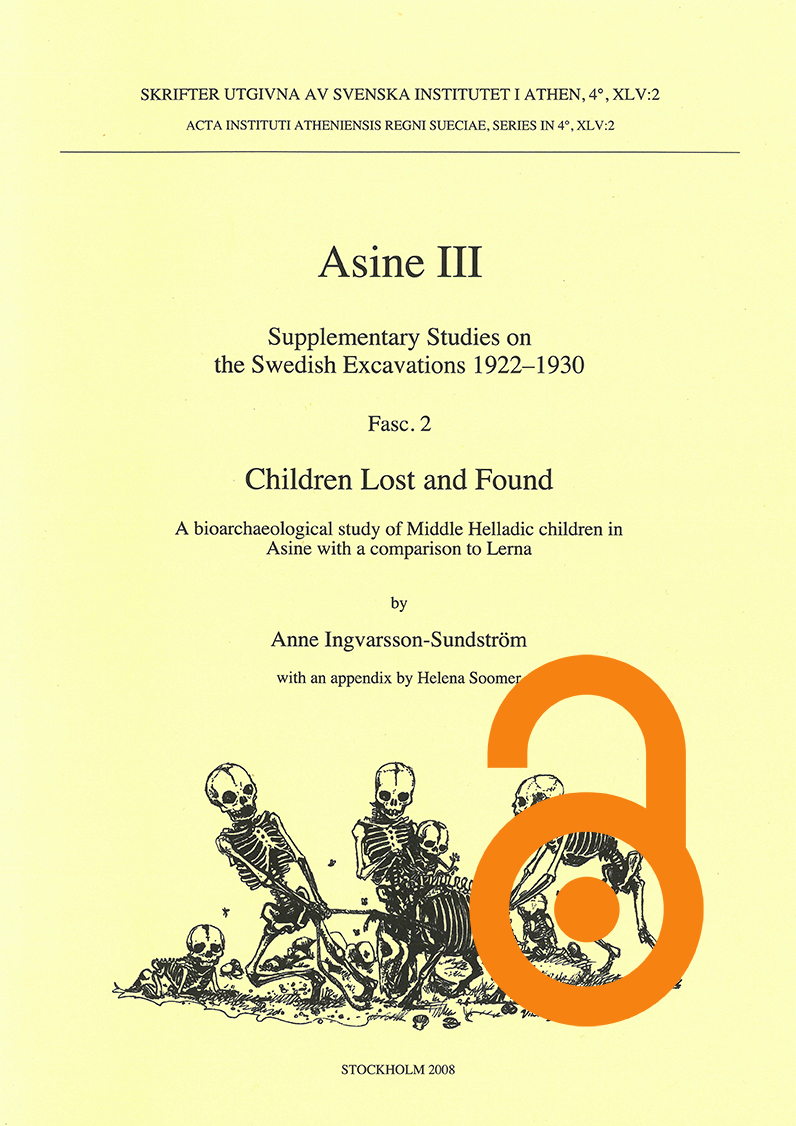
Published by the Swedish Institute at Athens. Distributed by Astrom Editions and Eddy.se AB. Asine 3. Supplementary studies in the Swedish excavations 1922–1930 Fasc. 1. Supplementary studies in the Swedish excavations 1922–1930 Edited by Robin Hägg, Gullög C. Nordquist & Berit Wells Abstract This is a collection of eleven papers inaugurating a new series of supplementary studies on the material from the old Swedish excavations at Asine. The first is a summary of the work undertaken between 1922 and 1930 and is intended to help in the study of the published reports and of the unpublished documentation. In further papers additional information is given on the Middle Helladic graves of the Lower Town, the Late Mycenaean terracotta head called “The Lord of Asine” is re-studied, and pottery and small finds from Mycenaean chamber tombs are discussed, including some technical aspects, such as the use of tin foil on pots. A group of Mycenaean vases from the village of Zafer Aga is published for the first time. Another paper deals with the animal bones from the Lower town of Asine. Finally, a concordance of the numbers of the graves and skeletons found at Asine is given as a tool for scholars…
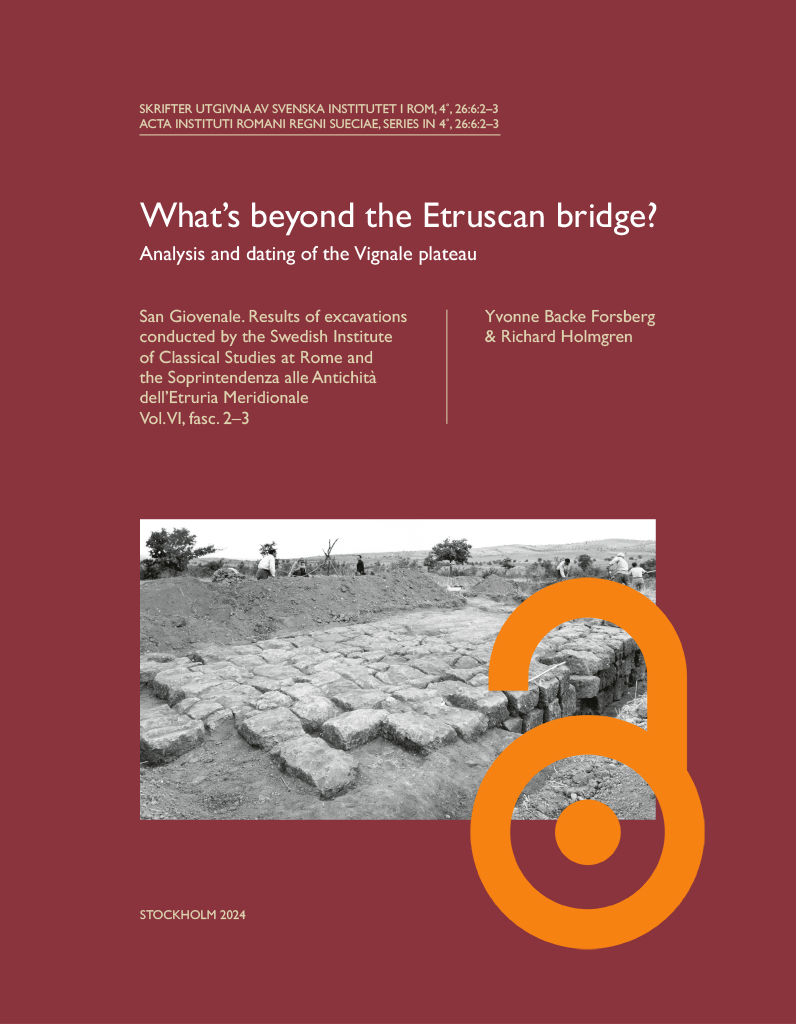
Published by the Swedish Institute of Classical Studies in Rome. Distributed by Astrom Editions and Eddy.se AB. San Giovenale. Results of excavations conducted by the Swedish Institute of Classical Studies at Rome and the Soprintendenza alle Antichità dell’Etruria Meridionale Vol. 1. Topographical introduction and history of excavations, photogrammatic methods and survey. Tombs Fasc. 1. Bengt E. Thomasson 1972. General introduction, Stockholm. ISSN 0081-993X. ISBN 9789170420078 (softcover: 12 pp.) Fasc. 2–3. Bertil Hallert 1967. Basics principles of photogrammetric methods used for measurements of San Giovenale & Bertil Hallert, Aerial photogrammetric survey of the San Giovenale area, Lund (softcover: 12 pp.) Fasc. 4. Carl Eric Östenberg 1972. The tombs: introduction, Stockholm. ISSN 0081-993X. ISBN: 9789170420085 (softcover: 16 pp.) Fasc. 5. Eric Berggren & Kristina Berggren 1972. The necropoleis of Porzarago, Grotte Tufarina and Montevangone. With drawings by Börje Blomé. With appendices by N.-G. Gejvall and Ruta Suksis-Jansson and with an addendum by Olof Vessberg, Stockholm. ISSN 0081-993X. ISBN 9789170420009 (softcover: 134 pp., 63 pls.) Fasc. 6. Carl Erik Östenberg & Olof Vessberg 1972. The necropolis at La Staffa, Stockholm. ISSN 0081-993X. ISBN 9789170420092 (softcover: 24 pp.) Fasc. 7. Carl Erik Östenberg 1969. The necropolis at Castellina Camerata, Lund (softcover: 29 pp.) Fasc. 8. Pär…
Published by the Swedish Institute at Athens. Out of print. Open access, use link below. The Dionysiac mysteries of the Hellenistic and Roman age By Martin P. Nilsson https://doi.org/10.30549/actaath-8-05 Conclusions (excerpt) The mysteries of Dionysos appealed to well-to-do people who loved a pleasant and luxurious life. The banquet of the blessed Dead appealed to the taste of a public that was fond of the pleasures of life and did not take religion too seriously. The mysteries of Dionysos appealed to people who from education and conservatism kept to the old culture and religion and yielded less easily to the lure of the more demanding foreign religions, but who still wanted a little thrill of religion as a spice to the daily routine. These characteristics explain the popularity of the Bacchic mysteries of the well-to-do classes, and they explain also why they have left so few traces, except for inscriptions and monuments, in the history of late paganism. These people were not in earnest about religion. The creation of new Dionysiac mysteries in the Hellenistic age and their popularity in Roman times, the attachment of their adherents to the enjoyment of life, their belief in a happy afterlife, their love of…