
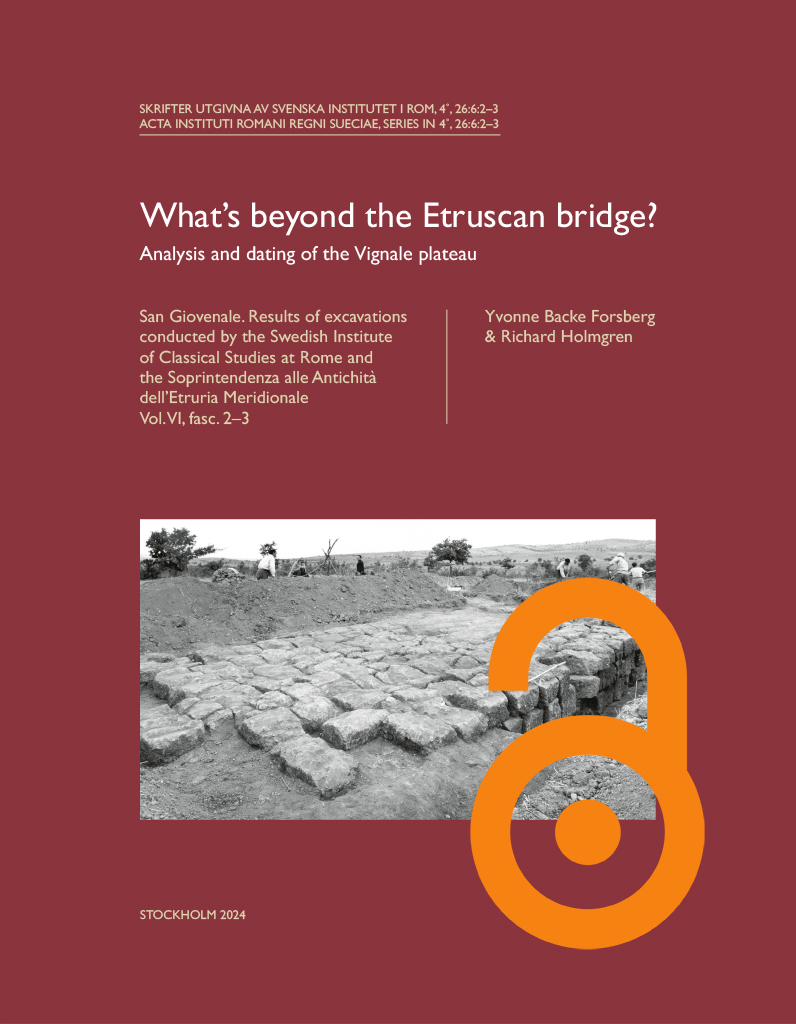
Published by the Swedish Institute of Classical Studies in Rome. Distributed by Astrom Editions and Eddy.se AB. San Giovenale. Results of excavations conducted by the Swedish Institute of Classical Studies at Rome and the Soprintendenza alle Antichità dell’Etruria Meridionale Vol. 1. Topographical introduction and history of excavations, photogrammatic methods and survey. Tombs Fasc. 1. Bengt E. Thomasson 1972. General introduction, Stockholm. ISSN 0081-993X. ISBN 9789170420078 (softcover: 12 pp.) Fasc. 2–3. Bertil Hallert 1967. Basics principles of photogrammetric methods used for measurements of San Giovenale & Bertil Hallert, Aerial photogrammetric survey of the San Giovenale area, Lund (softcover: 12 pp.) Fasc. 4. Carl Eric Östenberg 1972. The tombs: introduction, Stockholm. ISSN 0081-993X. ISBN: 9789170420085 (softcover: 16 pp.) Fasc. 5. Eric Berggren & Kristina Berggren 1972. The necropoleis of Porzarago, Grotte Tufarina and Montevangone. With drawings by Börje Blomé. With appendices by N.-G. Gejvall and Ruta Suksis-Jansson and with an addendum by Olof Vessberg, Stockholm. ISSN 0081-993X. ISBN 9789170420009 (softcover: 134 pp., 63 pls.) Fasc. 6. Carl Erik Östenberg & Olof Vessberg 1972. The necropolis at La Staffa, Stockholm. ISSN 0081-993X. ISBN 9789170420092 (softcover: 24 pp.) Fasc. 7. Carl Erik Östenberg 1969. The necropolis at Castellina Camerata, Lund (softcover: 29 pp.) Fasc. 8. Pär…
Published by the Swedish Institute at Athens. Out of print. Open access, use link below. The Dionysiac mysteries of the Hellenistic and Roman age By Martin P. Nilsson https://doi.org/10.30549/actaath-8-05 Conclusions (excerpt) The mysteries of Dionysos appealed to well-to-do people who loved a pleasant and luxurious life. The banquet of the blessed Dead appealed to the taste of a public that was fond of the pleasures of life and did not take religion too seriously. The mysteries of Dionysos appealed to people who from education and conservatism kept to the old culture and religion and yielded less easily to the lure of the more demanding foreign religions, but who still wanted a little thrill of religion as a spice to the daily routine. These characteristics explain the popularity of the Bacchic mysteries of the well-to-do classes, and they explain also why they have left so few traces, except for inscriptions and monuments, in the history of late paganism. These people were not in earnest about religion. The creation of new Dionysiac mysteries in the Hellenistic age and their popularity in Roman times, the attachment of their adherents to the enjoyment of life, their belief in a happy afterlife, their love of…
Published by the Swedish Institute at Athens. Distributed by Astrom Editions / out of print. Opuscula selecta, linguis Anglica, Francogallica, Germanica conscripta Vol. 1. By Martin P. Nilsson. Out of print. Open access, use link below. https://doi.org/10.30549/actaath-8-02-01 Lectori benevolenti Amicis et collegis, qui Actis Instituti Atheniensis Regni Sueciae praesunt, monentibus ut scripta mea minora collecta publici iuris facerem, tanta aestimatione mei sane valde gravisus sum. Neque tamen fieri non potuit, quin scrupulus quidam iniceretur, reputanti quanto simplicius negotium foret, si post mortem auctoris illa ederentur, quippe cum ad verbum, apertis solum mendis correctis, exprimi par esset. Qui vero sua ipse opera iterum prelo mandare audeat, ab eo tuo iure exspectes, ut illa diligenter, novissima quaeque scripta et inventa respiciens. Quod si ego facere aggressus essem, vereor ne futurum fuerit ut vitae spatium seni non sufficeret. Itaque satis habui paucissima et quae iamdudum adnotassem addere, more solito uncis inclusa. Menda tacitus correxi. Multa sane opuscula per longum aevum conscripsi, neque omnia denuo edere placuit. Exclusi fere: quae in seriem aliquam inserta tamen separatim veneunt; quae lingua suetica composita sunt (cum multa tum de vetustis moribus popularium meorum); quae in encyclopaediis, imprimis ea quam Pauly et Wissowa institerunt, disputavi; quae librorum alienorum existimator scripsi;…
Published by the Swedish Institute at Athens. Out of print. Open access, use link below. Cults, myths, oracles and politics in ancient Greece By Martin P. Nilsson https://doi.org/10.30549/actaath-8-01 Preface This little book is an outcome of some leisure hours, spared from more exacting work. It does not pretend to offer anything new, but as the facts have never been collected and as some unwarranted opinions on the interrelation of Greek mythology and cults and the social and political life of the Greeks have been put forward, a comprehensive survey may be of some use. Oracles were also part of Greek religion and were extensively used for influencing public opinion. They are treated in a separate chapter. I append a discussion of the Ionian phylae and another of the phratries. They are highly technical and the result is meagre, but they have some importance as throwing light upon the interplay of religion and social life. I am deeply indebted to Professors A. Wifstrand and Hj. Frisk for valuable and clarifying help in certain difficult problems. My warmest thanks are due to Professor H.J. Rose who, with self-sacrificing kindness, has gone through my manuscript, correcting my English style, and read the first…
