Opuscula is published by the Swedish Institutes at Athens and Rome, with the aid of a grant from the Swedish Research Council. Distributed by Eddy.se AB. View journal at ERIH PLUS. All content available with open access at the platform Publicera, hosted by the National Library of Sweden, use links below. Opuscula. Annual of the Swedish Institutes at Athens and Rome 14, 2021 Contents Articles Gourimadi Archaeological Project. The results from the first excavation season (2018) of a prehistoric site in the Karystia, southern Euboea By Žarko Tankosić, Fanis Mavridis, Paschalis Zafeiriadis & Aikaterini Psoma, pp. 7–26, https://doi.org/10.30549/opathrom-14-02 The Kalaureia Excavation Project. A preliminary report of the work carried out in Area L between 2015 and 2018 By Anton Bonnier, Therese Emanuelsson-Paulson, Dimitra Mylona & Arto Penttinen, pp. 27–54, https://doi.org/10.30549/opathrom-14-03 Some preliminary notes on the limited 2020 campaign of the Palamas Archaeological Project (PAP) By Maria Vaïopoulou, Robin Rönnlund, Fotini Tsiouka, Derek Pitman, Sotiria Dandou, Rich Potter & Johan Klange, pp. 55–63, https://doi.org/10.30549/opathrom-14-04 An ancient cityscape and its people: A study of ancient Hermione. Introductory remarks on historical sources and visible remains, archaeological research and prospects By Alcestis Papadimitriou, pp. 65–76, https://doi.org/10.30549/opathrom-14-05 The topography of Hermione—A preliminary outline By Henrik Gerding,…
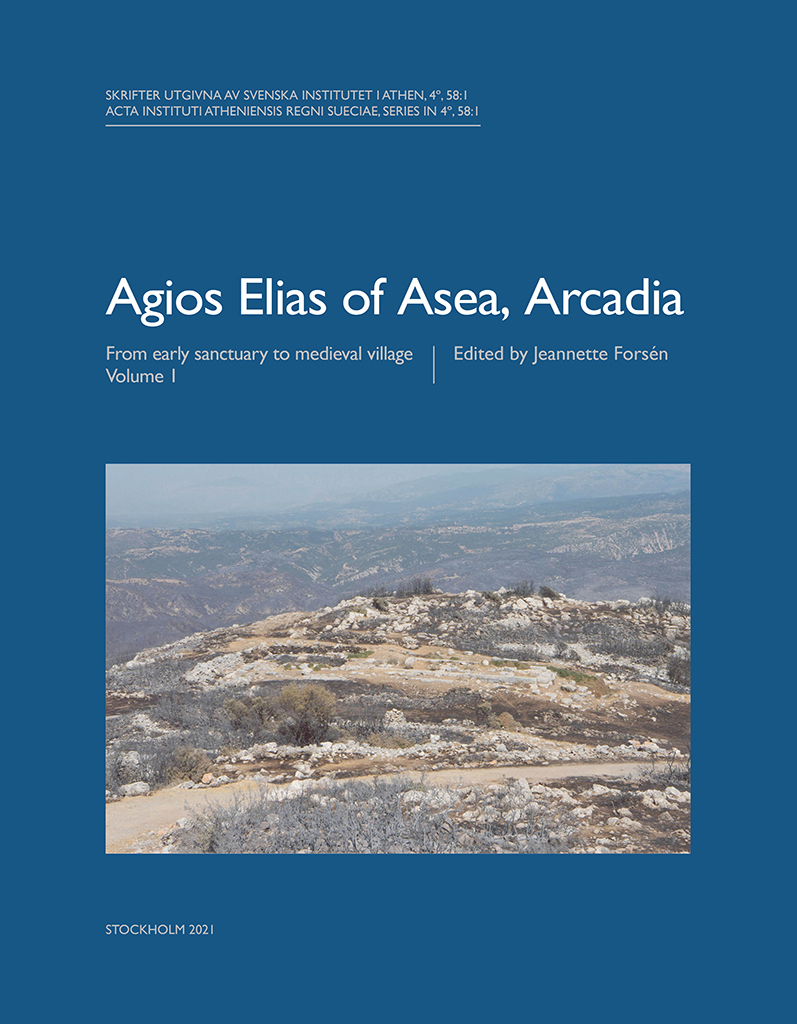
Published by the Swedish Institute at Athens. Distributed by Eddy.se AB. Agios Elias of Asea, Arcadia Vol. 1. Agios Elias of Asea, Arcadia. From early sanctuary to medieval village Edited by Jeannette Forsén Abstract A brief four-week excavation campaign in 1997 at the temple on top of the mountain of Agios Elias at Asea produced abundant archaeological material which partly is presented in this study, along with a stratigraphic report of part of the excavated area. The pottery, miniature vessels, miscellaneous terracotta finds, roof tiles, faunal and human bones, glass, coins, sculpture and miscellaneous stone objects are included in the present work. The first focus of activities at the site took place around c. 720–690 BC (Early Protocorinthian). No architecture was found in connection with this period. However, roof tiles of a temple and some auxiliary buildings from c. 590–560 BC (Middle Corinthian–Late Corinthian I) are accompanied by a large amount of pottery which point at a second floruit of the site during this period. Some of the pottery is local/regional, with other examples originating from many parts of southern Greece in addition to Attica and possibly East Greece as well. During the 14th century AD a village, named Kandreva,…
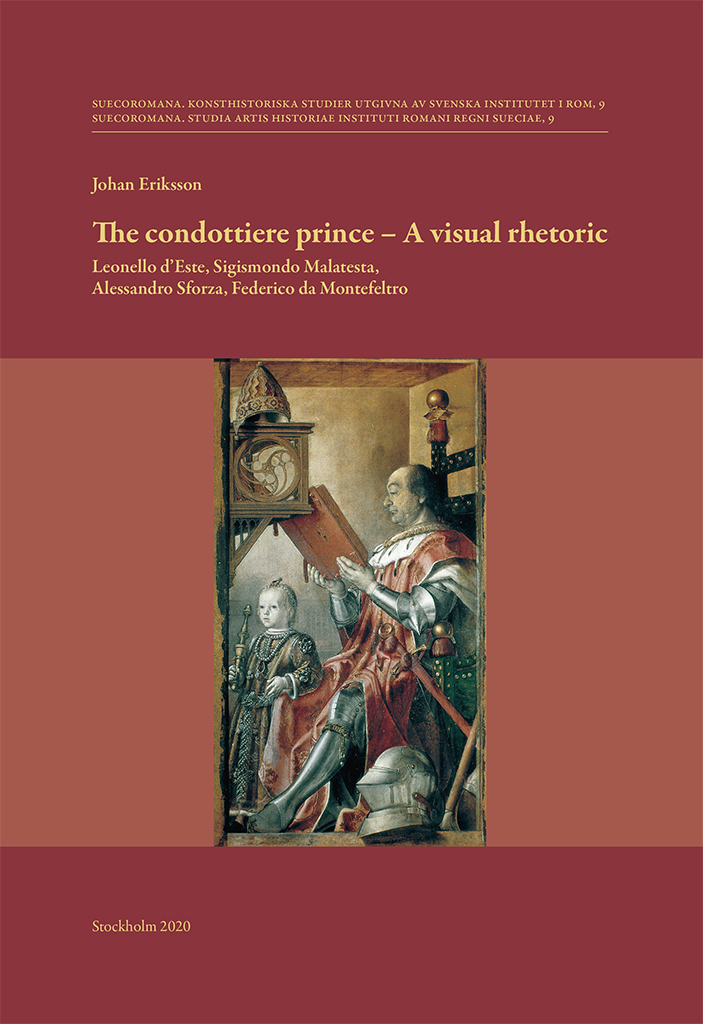
Published by the Swedish Institute of Classical Studies in Rome. Distributed by Eddy.se AB. The condottiere prince – A visual rhetoric. Leonello d’Este, Sigismondo Malatesta, Alessandro Sforza, Federico da Montefeltro By Johan Eriksson Abstract The aim of this study is to display the role of the patrons in the commissions of Italian Renaissance art and architecture, but also to describe their usage of art and architecture for visual communication. For this purpose four condottiere princes from the 15th century have been chosen to exemplify these phenomena. By reconstructing and comparing commissions and artefacts from the courts of Leonello d’Este in Ferrara, Sigismondo Malatesta in Rimini, Alessandro Sforza in Pesaro and Federico da Montefeltro in Urbino with the political history, the visual language and the propagandists function of art are being described. The first chapter is an introduction to the subject and the four following ones are chronological accounts for and interpretations of the condottiere princes’ visual rhetoric. In a concluding chapter the visual language of the four princes are compared and a deeper interpretation is launched, the perspective is widened and the heritage of the princely rhetoric is depicted. The activities of the condottieri was a phenomenon which culminated at…
Opuscula is published by the Swedish Institutes at Athens and Rome, with the aid of a grant from the Swedish Research Council. Distributed by Eddy.se AB. View journal at ERIH PLUS. All content available with open access at the platform Publicera, hosted by the National Library of Sweden, use links below. Opuscula. Annual of the Swedish Institutes at Athens and Rome 13, 2020 Contents Articles The 2016–2018 Greek-Swedish archaeological project at Thessalian Vlochos, Greece By Maria Vaïopoulou, Helene Whittaker, Robin Rönnlund, Fotini Tsiouka, Johan Klange, Derek Pitman, Rich Potter, Lawrence Shaw, Josephine Hagan, Ellen Siljedahl, Matilda Forssén, Sujatha Chandrasekaran, Sotiria Dandou, Veronica Forsblom Ljungdahl, Asta Pavilionytė, Hayden Scott-Pratt, Elisabet Schager & Harry Manley, pp. 7–72, https://doi.org/10.30549/opathrom-13-02 The New Swedish Cyprus Expedition 2019: Excavations at Hala Sultan Tekke (The Söderberg Expedition). Preliminary results By Peter M. Fischer & Teresa Bürge, with contributions by L. Recht, B. Placiente Robedizo, C. Eriksson, L. Andersson, M. Svensson, L. Avial Chicharro, S. Hermon, M. Polig & D. Kofel pp. 73–111, https://doi.org/10.30549/opathrom-13-03 A Mycenaean pictorial vase from Midea By Katie Demakopoulou, pp. 113–121, https://doi.org/10.30549/opathrom-13-04 A Protocorinthian aryballos with a myth scene from Tegea By Erik Østby, pp. 123–138, https://doi.org/10.30549/opathrom-13-05 Religion and family politics in Hellenistic Kalaureia….
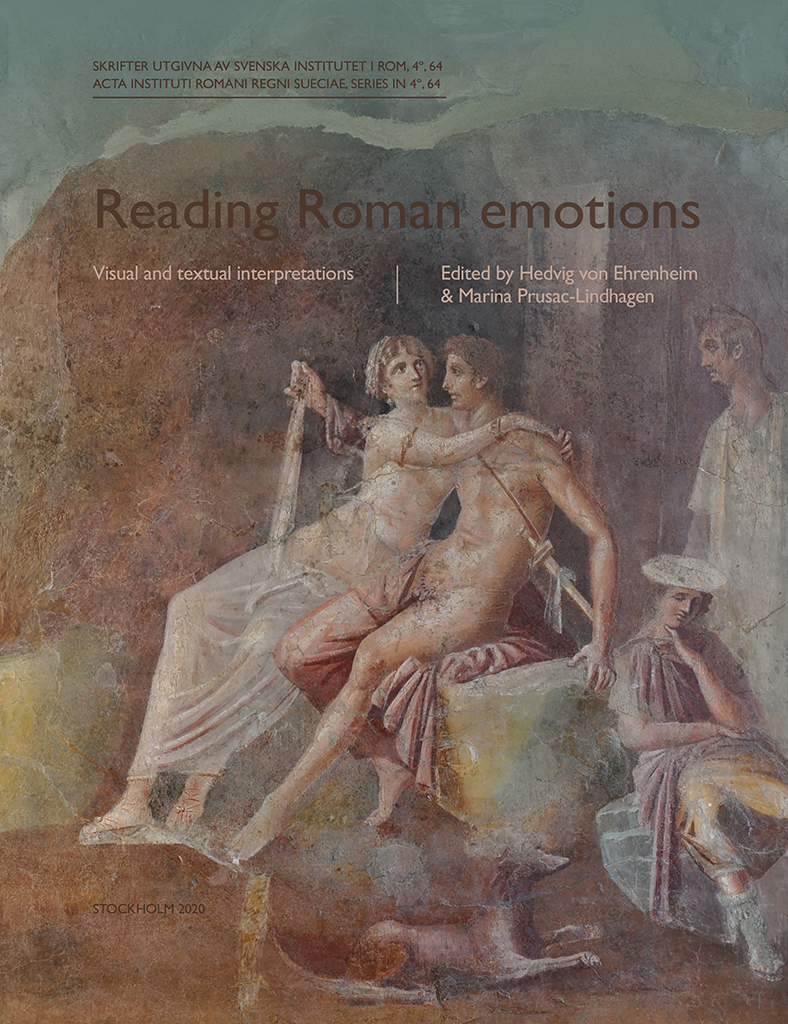
Published by the Swedish Institute of Classical Studies in Rome. Distributed by Eddy.se AB. Reading Roman emotions. Visual and textual interpretations Edited by Hedvig von Ehrenheim & Marina Prusac-Lindhagen Abstract This volume is a contribution to the study of culturally bound emotions and emotional response in ancient Rome. Approaches to the study of ancient emotions and how they were culturally specific, appreciated and understood have recently come to the centre of attention, but not so much in the visual as in the literary culture. When socially and affectively contextualized, the material culture of ancient Rome is a potential goldmine of information with regard to emotions. The chapters in the present volume take the reader on a tour through various cases that demonstrate how emotions were expressed through the arts. The tour starts with a fresh view of how emotion history can be used to recover feelings from the visual culture of the past. Visual culture includes animated performances, and the reader is invited to revel in Roman drama, oratory, and love poetry. Words are often clear, but can images reveal laughter and joy, sadness, grief and mourning, virtue and anger? This volume argues that yes, they can, and through the…
Opuscula is published by the Swedish Institutes at Athens and Rome, with the aid of a grant from the Swedish Research Council. Distributed by Eddy.se AB. View journal at ERIH PLUS. All content available with open access at the platform Publicera, hosted by the National Library of Sweden, use links below. Opuscula. Annual of the Swedish Institutes at Athens and Rome 12, 2019 Contents Articles Bioarchaeological field analysis of human remains from the mass graves at Phaleron, Greece By Anne Ingvarsson, Ylva Bäckström, Stella Chryssoulaki, Anna Linderholm, Anna Kjellström, Vendela Kempe Lagerholm & Maja Krzewińska, pp. 7–158, https://doi.org/10.30549/opathrom-12-02 Physical environment and daily life in the Sanctuary of Poseidon at Kalaureia, Poros. The bioarchaeological remains. Introduction By Arto Penttinen & Dimitra Mylona, pp. 159–172, https://doi.org/10.30549/opathrom-12-03 Animals in the sanctuary. Mammal and fish bones from Areas D and C at the Sanctuary of Poseidon at Kalaureia By Dimitra Mylona & Adam Boethius, 173–221, https://doi.org/10.30549/opathrom-12-04 Animals in the sanctuary. Bird bones and eggshell By Dale Serjeantson, pp. 223–231, https://doi.org/10.30549/opathrom-12-05 Snakes and other microfaunal remains from the Sanctuary of Poseidon at Kalaureia By Petros Lymberakis & Giorgos Iliopoulos, pp. 233–240, https://doi.org/10.30549/opathrom-12-06 Marine and terrestrial molluscs in the sanctuary. The molluscan remains from the 2003–2004…
Published by the Swedish Research Institute in Istanbul (SRII) and distributed by Eddy.se AB at srii.bokorder.se. Also available for purchase at Amazon.com, Bokus.com, and Adlibris.com. The Labraunda-series is edited by the Editorial Committee of the Swedish Institutes at Athens and Rome. Labraunda 5. The Andrones By Pontus Hellström and Jesper Blid Abstract This is the final publication of the two Hekatomnid Andrones at Labraunda. The older of these (the Andron of Maussollos or Andron B) was built by the satrap Maussollos (377/6–353/2 BC). This is shown by the dedicatory inscription on the architrave. The other andron (Andron A) is clearly later and was probably built by Idrieus (351/0 344/3 BC), the brother and successor of Maussollos as satrap of Karia. This building has the same kind of dedication, but the name of the commissioner is not preserved. These two buildings are unique both for their size, temple-like front, and high degree of preservation and for their Ionic-Doric mixed order, the function as banqueting halls, and the large niche at the back of the inner room. In the publication the architecture of the two buildings is systematically presented together with plans and elevations of the ruins and reconstructions. The walls are…
Opuscula is published by the Swedish Institutes at Athens and Rome, with the aid of a grant from the Swedish Research Council. Distributed by Eddy.se AB. View journal at ERIH PLUS. All content available with open access at the platform Publicera, hosted by the National Library of Sweden, use links below. Opuscula. Annual of the Swedish Institutes at Athens and Rome 11, 2018 Contents Articles Preliminary report of the Malthi Archaeological Project, 2015–2016 By Rebecca Worsham, Michael Lindblom & Claire Zikidi, pp. 7-27, https://doi.org/10.30549/opathrom-11-02 The New Swedish Cyprus Expedition 2017: Excavations at Hala Sultan Tekke (The Söderberg Expedition). Preliminary results. By Peter M. Fischer & Teresa Bürge, with contributions by M. Ausiayevich, B. Placiente Robedizo, V. Barrera Alarcón, L. Recht & D. Kofel, pp. 30-79, https://doi.org/10.30549/opathrom-11-03 Two Early Helladic II terracotta rollers from Asine and their glyptic context By Michael Lindblom, Gullög Nordquist & Hans Mommsen, pp. 81-96, https://doi.org/10.30549/opathrom-11-04 Tokens of piety. Inexpensive dedications as functional and symbolic objects By Gina Salapata, pp. 97-109, https://doi.org/10.30549/opathrom-11-05 The use of miniature pottery in Archaic–Hellenistic Greek sanctuaries. Considerations on terminology and ritual practice By Signe Barfoed, pp. 111-126, https://doi.org/10.30549/opathrom-11-06 Painting early death. Deceased maidens on funerary vases in the National Archaeological Museum…
Opuscula is published by the Swedish Institutes at Athens and Rome, with the aid of a grant from the Swedish Research Council. Distributed by Eddy.se AB. View journal at ERIH PLUS. All content available with open access at the platform Publicera, hosted by the National Library of Sweden, use links below. Opuscula. Annual of the Swedish Institutes at Athens and Rome 10, 2017 Contents Articles Clay paste characterization and provenance determination of Middle and Late Helladic vessels from Midea By Katie Demakopoulou, Nicoletta Divari-Valakou, Joseph Maran, Hans Mommsen, Susanne Prillwitz & Gisela Walberg, pp. 7–49, https://doi.org/10.30549/opathrom-10-02 The New Swedish Cyprus Expedition 2016. Excavations at Hala Sultan Tekke (The Söderberg Expedition). Preliminary results By Peter M. Fischer, Teresa Bürge, Laerke Recht, Dominika Kofel, David Kaniewski, Nick Marriner & Christophe Morhange, pp. 50–93, https://doi.org/10.30549/opathrom-10-03 Power and coinage. The portrait tetradrachms of Eumenes II By Marie-Christine Marcellesi, pp. 94–106, https://doi.org/10.30549/opathrom-10-04 The stadion of Labraunda By Paavo Roos, pp. 107–127, https://doi.org/10.30549/opathrom-10-05 Symbolic connotations of animals at early Middle Helladic Asine. A comparative study of the animal bones from settlement and its graves By Stella Macheridis, pp. 128–152, https://doi.org/10.30549/opathrom-10-06 The lower city of Asea, Arcadia. Results from a geophysical project 2001–2012 By Jeannette Forsén,…
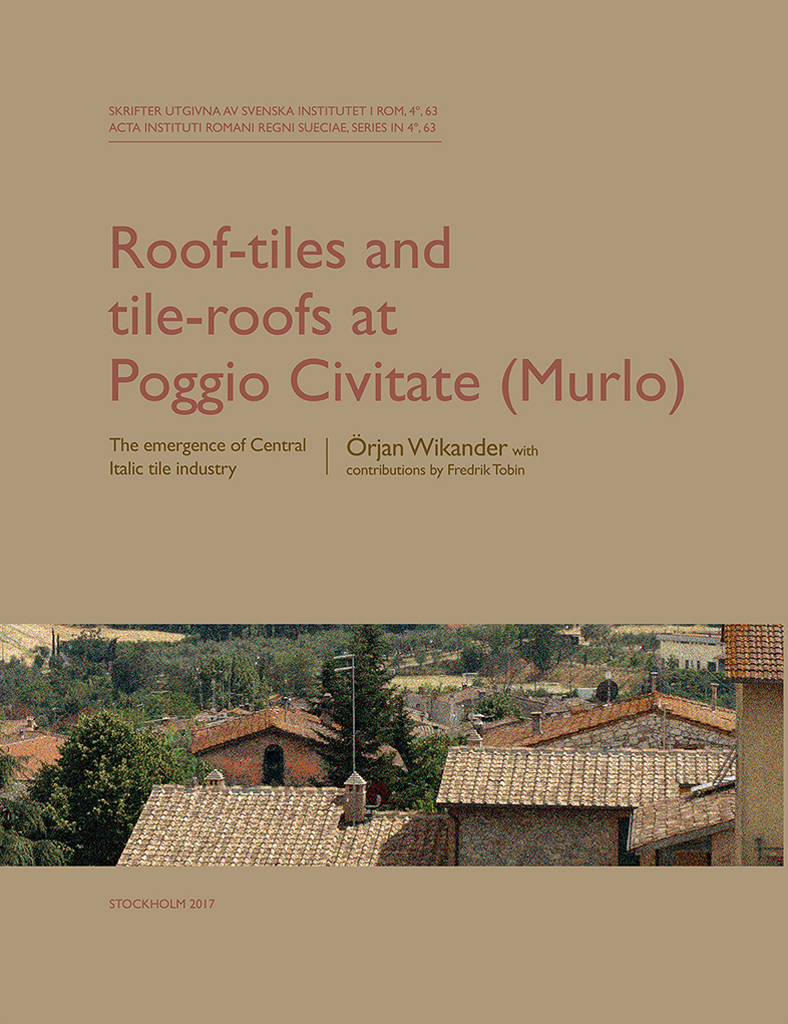
Published by the Swedish Institute of Classical Studies in Rome. Distributed by Eddy.se AB. Roof-tiles and tile-roofs at Poggio Civitate (Murlo). The emergence of Central Italic tile industry By Örjan Wikander, with contributions by Fredrik Tobin Abstract This book has various aims: presenting and discussing the roof-tiles discovered at Poggio Civitate, trying to reconstruct the many roofs they once covered, and outlining the general development of roof-tiles and tiled roofs in Central Italy during the period from c. 650 to 200 BC. Moreover, it also brings the authors earlier studies of skylight-tiles and Archaic simas up to date. Five chapters present typological features of separate tile categories (Ch. I), distribution of terracottas (including the decorative ones) on various roofs (Ch. II), technical issues concerning the production of tiles, their placement on roofs and the collapse of these roofs (Ch. III), plastic and painted decoration (Ch. IV), and the conclusions that can be drawn concerning the chronology of the Poggio Civitate roofs together with a sketch of the introduction and early diffusion of tiled roofs in Central Italy (Ch. V). In one of the appendices letters and signs found on more than three hundred Poggio Civitate tiles are presented and discussed…