
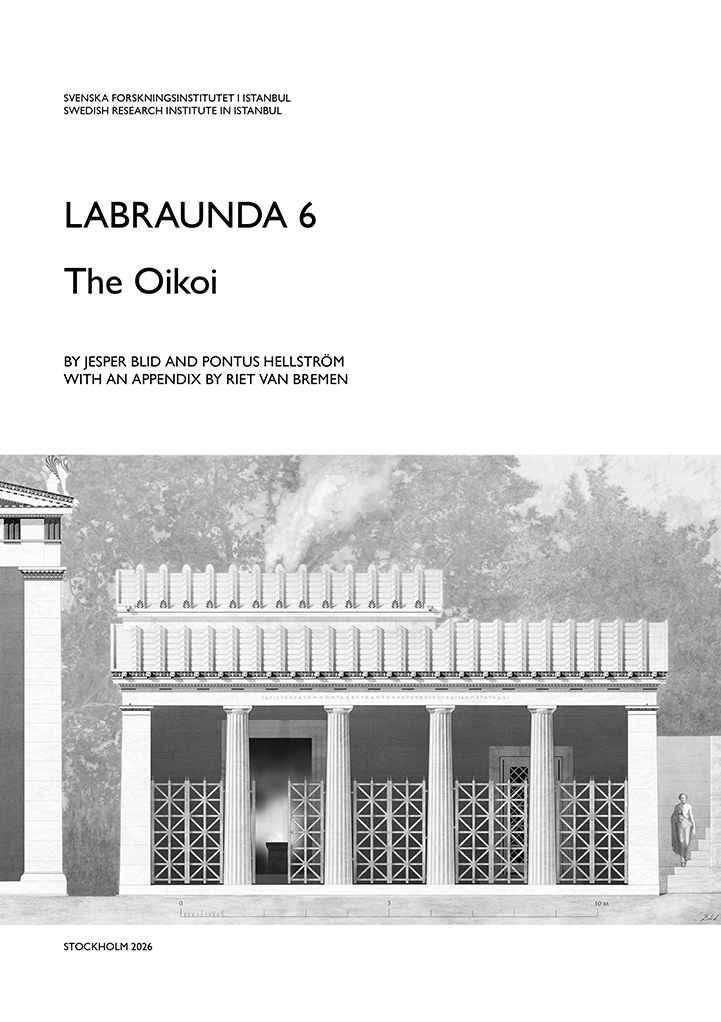
Published by the Swedish Research Institute in Istanbul (SRII) and distributed by Eddy.se AB at srii.bokorder.se. Also available for purchase at Amazon.se, Bokus.com, and Adlibris.com. The Labraunda-series is edited by the Editorial Committee of the Swedish Institutes at Athens and Rome. Labraunda 6. The Oikoi By Jesper Blid, Pontus Hellström and Riet Van Bremen Abstract This is the final publication of the Hekatomnid Oikoi at Labraunda. According to the dedicatory inscription on the architrave, it was built by Idrieus (351/0 to 344/3 BC), who was the brother of Maussollos and his successor as satrap of Karia. The excavations and the architecture of the building are systematically presented in the volume, together with plans and elevations of the building and reconstructions. A catalogue of marble blocks from the antae, the columns, the entablature, and the roof is included, as well as a large collection of photographs and drawings. The building consists of two rooms behind a porch. The walls are of local gneiss, and the front, which has four columns in antis, is of marble. The columns and the epistyle are Doric, but there is no triglyph frieze, and the geison is Ionic. The building is reconstructed with two separate roofs of marble: one pitched roof covering…
Published by the Swedish Research Institute in Istanbul (SRII) and distributed by Eddy.se AB at srii.bokorder.se. Also available for purchase at Amazon.com, Bokus.com, and Adlibris.com. The Labraunda-series is edited by the Editorial Committee of the Swedish Institutes at Athens and Rome. Labraunda 5. The Andrones By Pontus Hellström and Jesper Blid Abstract This is the final publication of the two Hekatomnid Andrones at Labraunda. The older of these (the Andron of Maussollos or Andron B) was built by the satrap Maussollos (377/6–353/2 BC). This is shown by the dedicatory inscription on the architrave. The other andron (Andron A) is clearly later and was probably built by Idrieus (351/0 344/3 BC), the brother and successor of Maussollos as satrap of Karia. This building has the same kind of dedication, but the name of the commissioner is not preserved. These two buildings are unique both for their size, temple-like front, and high degree of preservation and for their Ionic-Doric mixed order, the function as banqueting halls, and the large niche at the back of the inner room. In the publication the architecture of the two buildings is systematically presented together with plans and elevations of the ruins and reconstructions. The walls are…
Published by the Swedish Institute at Athens. Distributed by Astrom Editions. Labraunda. Swedish excavations and researches Vol. 1. Architecture Fasc. 1. The Propylaea By Kristian Jeppesen Contents Introduction The South Propylaea Foundations Technical premises Descriptions and restoration of the superstructure Summary The East Propylaea Foundation Descriptions and restoration of the superstructure Summary An attempt at a theoretical analysis General premises The South Propylaea The East Propylaea Bibliographical information Kristian Jeppesen 1955. Labraunda. Swedish excavations and researches vol. 1. Architecture part. 1 The Propylaea (Skrifter utgivna av Svenska institutet i Athen, 4°, 5:1:1), Lund. ISSN 0586-0539. Alternative series title: Acta Instituti Atheniensis Regni Sueciae series in 4˚, V:I:1 Fasc. 2. The architecture of the Hieron By Alfred Westholm Contents Introduction Labraunda in travellers reports Topography Description of the architecture of the Hieron Architectural analysis Architectural synthesis and chronological discussions Bibliographical information Alfred Westholm 1963. Labraunda. Swedish excavations and researches vol. 1. Architecture fasc. 2. The architecture of the Hieron (Skrifter utgivna av Svenska institutet i Athen, 4°, 5:1:2), Lund. ISSN 0586-0539. Alternative series title: Acta Instituti Atheniensis Regni Sueciae series in 4˚, V:I:2 Vol. 2. Finds Fasc. 1. Pottery of Classical and later date, terracotta lamps and glass By Pontus Hellström…
