ActaAth-8°, 18: Greek sacrificial ritual, Olympian and chthonian (2005)

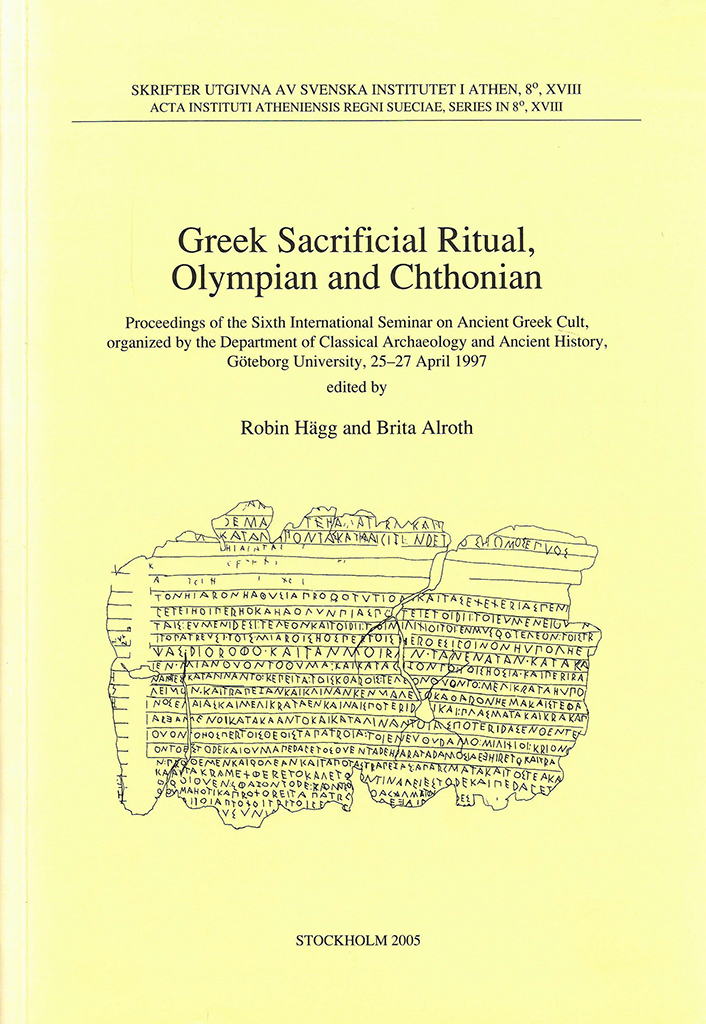
Published by the Swedish Institute at Athens. Distributed by Astrom Editions. Greek sacrificial ritual, Olympian and Chthonian. Proceedings of the Sixth International Seminar on Ancient Greek Cult, organized by the Department of Classical Archaeology and Ancient History, Göteborg University, 25–27 April 1997 Edited by Robin Hägg & Brita Alroth Abstract A collection of eighteen papers, read or circulated at an international seminar in Göteborg, that deal with the ancient Greek sacrificial ritual, with special reference to the traditional dichotomy between the Olympian and the chthonian aspect, the relevance of which has been questioned in modern research. Among the special topics discussed are sacrifices to heroes and in the cult of the dead, magical sacrifice, sacrifice to the sea, pig sacrifice and the sacrifice of pregnant animals. Other aspects dealt with include the role of dedications in the cult and the practicalities of ruler-cult, as well as the priest’s role in Greek sacrifice. Several contributions discuss the implications of the recently published lex sacra from Selinous for the understanding of Greek sacrificial practice, reinterpreting previously known inscriptions in the light of the new evidence. Two papers deal with descriptions of sacrifice in Greek tragedy (Aeschylus, Oresteia; Sophocles, Trachiniae). There is a…
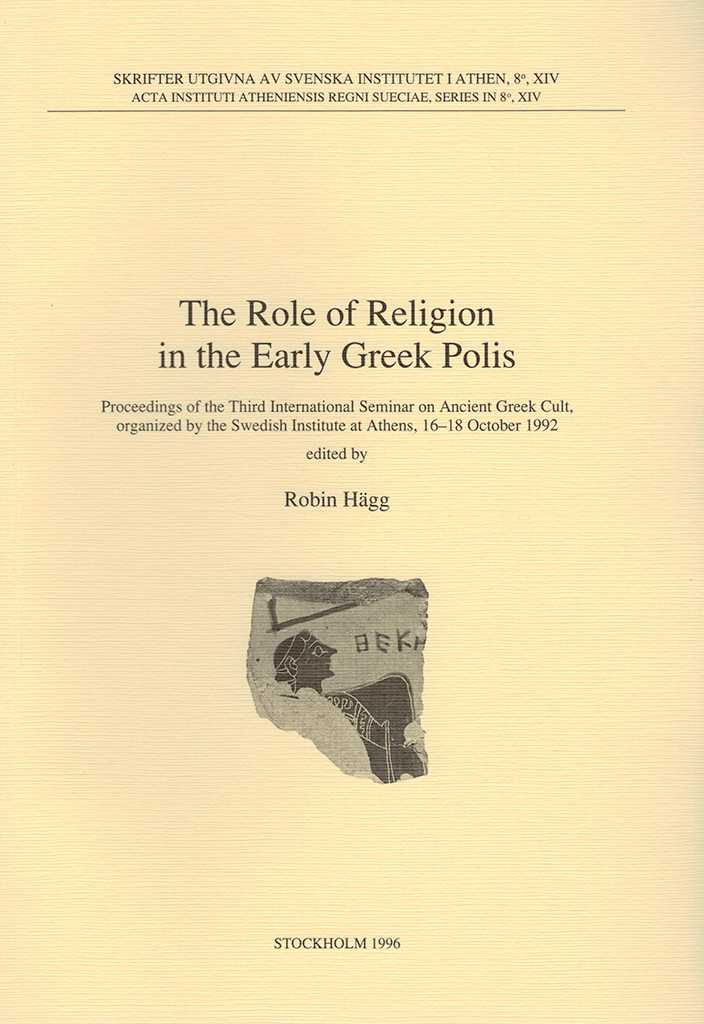
ActaAth-8°, 14: The role of religion in the early Greek polis (1996)

Published by the Swedish Institute at Athens. Distributed by Astrom Editions. The role of religion in the early Greek polis. Proceedings of the Third International Seminar on Ancient Greek Cult, organized by the Swedish Institute at Athens, 16–18 October 1992 Edited by Robin Hägg Abstract These twelve papers read at an international seminar in Athens deal with various aspects of the role of religion in the early Greek polis, based on the epigraphical, iconographical and archaeological evidence. Among the special topics discussed are territorial myths and the mythical articulations with regard to the early polis, the Greek temple-builders, the distribution of offerings and rituals between graves and sanctuaries, the development of sacred and profane civic ideology in Athens, processions (pompai), verbal and ritual obscenity in women’s cults, prohibitionary inscriptions, the role of the seer, the Thesmophorion in central Athens, the cults in Solonian Athens, cults by the seashore and Dionysos at Argos. Contents ‘Preface’, p. 7 Irad Malkin, ‘The polis between myths of land and territory’, pp. 9–19 Walter Burkert, ‘Greek temple builders: who, where and why?’, pp. 21–29 François de Polignac, ‘Entre les dieux et les morts. Statut individual et rites collectifs dans la cite archaïque’, pp. 31–40 Sanne…

ActaAth-8°, 13: Ancient Greek cult practice from the epigraphical evidence (1994)

Published by the Swedish Institute at Athens. Distributed by Astrom Editions. Ancient Greek cult practice from the epigraphical evidence. Proceedings of the Second International Seminar on Ancient Greek Cult organized by the Swedish Institute at Athens, 22–24 November 1991 Edited by Robin Hägg Abstract Thirteen papers read at an international seminar in Athens deal with various phenomena of Greek cult practice, analysing the information contained in inscriptions, such as sacred laws. Among the special topics discussed are: the definition of “state cult”, the arrival of Asclepius in Athens, the rite of theoxenia, regulations concerning everyday life in a Greek temenos, the occurrence of cakes in sacrifice regulations, the food and drink at two festivals on Delos, the role of musicians in Greek cult, the sacred laws of Lykosoura, the cult of Artemis Ortheia at Messene, the cult of Poseidon-Erechtheus on the Acropolis of Athens, the interpretation of lead curse tablets and other magical texts in Greek from Cyprus and Asia Minor. Contents ‘Preface’, p. 7. Sara B. Aleshire, ‘Towards a definition of “state cult” for ancient Athens’, pp. 9–16. Kevin Clinton, ‘The Epidauria and the arrival of Asclepius in Athens’, pp. 17–34. Michael H. Jameson, ‘Theoxenia’, pp. 35–57. György Németh, Μεδ’ ὄνθον…

ActaAth-8°, 11: Myth and cult (1992)
ActaAth-8° / 1992-01-01

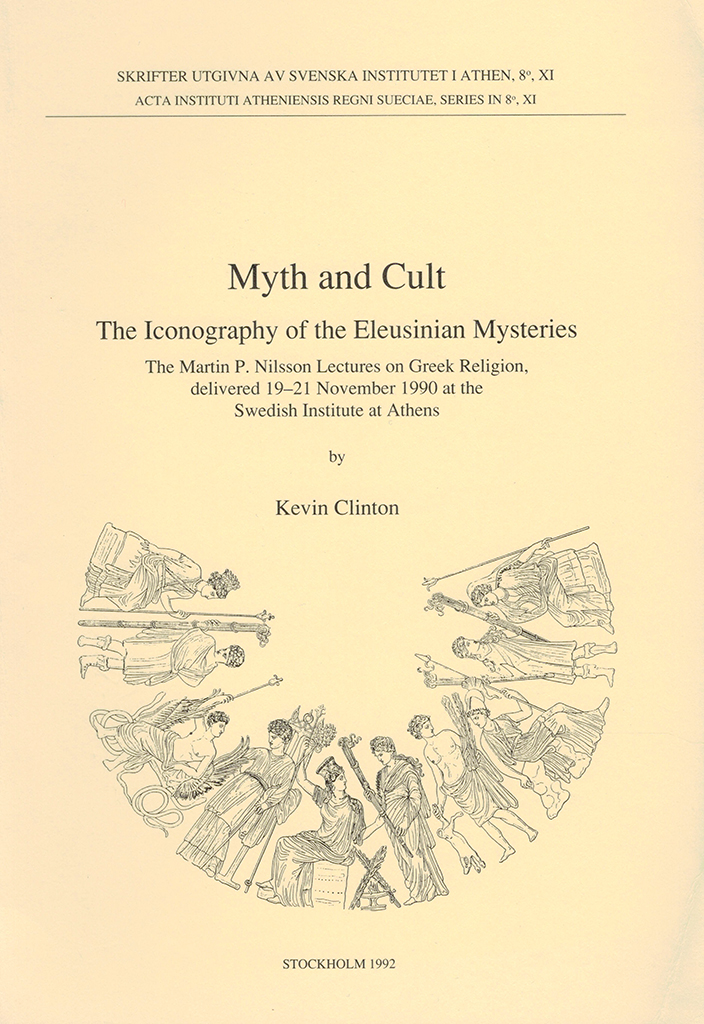
Published by the Swedish Institute at Athens. Distributed by Astrom Editions. Myth and cult. The iconography of the Eleusinian Mysteries. The Martin P. Nilsson Lectures on Greek Religion, delivered 19–21 November 1990 at the Swedish Institute at Athens By Kevin Clinton Abstract Iconography serves as the starting part for the treatment of central aspects of the myth and cult of the Eleusinian Mysteries. The presence of the Mirthless Rock in artistic presentations, its location in the sanctuary, and its relation to the Callichoron Well provide a perspective for assessing the aetiological elements in the Homeric Hymn to Demeter and the relation of the Hymn to Eleusis. The Iconography of Eubouleus, Iakchos, and Eumolpos is established, and that of Triptolemos and Ploutos is discussed extensively. The importance of Eubouleus in artistic representations is seen to correspond to his importance in the Mysteries, and the identification of him in certain scenes reveals his function in the myth of the Mysteries. Discussion of his role in the Thesmophoria leads to an examination of the relation of the Mysteries to the Thesmophoria. The various roles of all these figures in artistic representations provide a basis for revised interpretations of several works of art, and…

ActaAth-4°, 38: Early Greek cult practice (1988)

Published by the Swedish Institute at Athens. Distributed by Astrom Editions. Early Greek cult practice. Proceedings of the Fifth International Symposium at the Swedish Institute at Athens, 26-29 June, 1986 Edited by Robin Hägg, Nanno Marinatos & Gullög C. Nordquist Abstract Twenty-eight papers on the phenomena of early Greek cult practice, concentrating on the Late Geometric, Archaic and Classical periods, read at an international conference in Athens; the papers are followed by transcripts of the discussions of the symposium. The papers are arranged in eight groups, discussing (1) animal sacrifice, Minoan to Greek, (2) Greek sacrificial ritual, (3) early cults at Knossos and Sparta, (4) temples, altars, cult images and ritual meals, (5) water in the cult, (6) votive offerings, (7) cult practice and cultural anthropology, and (8) special cults and cult practices (including cults of heroes, veneration of ancestors, ritual haircuts and building sacrifices).  Contents ‘Preface’, p. 7 Animal sacrifice, Minoan to Greek Nanno Marinatos, ‘The imagery of sacrifice: Minoan and Greek’, pp. 9–20 Birgitta Bergquist, ‘The archaeology of sacrifice: Minoan-Mycenaean versus Greek’, pp. 21–34 B.C. Dietrich, ‘The instrument of sacrifice’, pp. 35–40 Demetrius U. Schilardi, ‘The temple of Athena at Koukounaries. Observations on the cult of Athena on…

ActaAth-4°, 34: Opuscula Atheniensia 16 (1986)

Published by the Swedish Institute at Athens. Distributed by Astrom Editions. Opuscula Atheniensia 16 Contents Paul Åström, ‘Hala Sultan Tekke—an international harbour town of the Late Cypriot Bronze Age’, pp. 7–17. Paul Åström & Katie Demakopoulou, ‘New excavations in the Citadel of Midea, 1983–1984’, pp. 19–25. Paul Åström, R. Maddin, J.D. Muhly & T. Stech, ‘Iron artifacts from Swedish excavations in Cyprus’, pp. 27–41. Kevin Clinton, ‘The author of the Homeric Hymn to Demeter’, pp. 43–49. Harold D. Evjen, ‘Competitive athletics in ancient Greece: the search for origins and influences’, pp. 51–56. Nanno Marinatos & Robin Hägg, ‘On the ceremonial function of the Minoan polythyron’, pp. 57–73. Erik Østby, ‘The archaic temple of Athena Alea at Tegea’, pp. 75–102. Eva Rystedt, ‘The foot-race and other athletic contests in the Mycenaean world. The evidence of the pictorial vases’, pp. 103–116. Charlotte Scheffer, ‘Some further comments on the gorgoneion skyphoi’, pp. 117–122. Miscellanea Yvonne Backe-Forsberg & Christina Risberg, ‘Metal working at Asine. ‘New’ finds from the 1926 season’, pp. 123–125. Robert B. Koehl, ‘Another look at the Mycenaean Base Ring vase from the Athenian Agora’, pp. 125–126. David Symons, ‘An unpublished  tomb group from Paphos’, pp. 127–130. Robin Hägg, ‘The Swedish Institute…