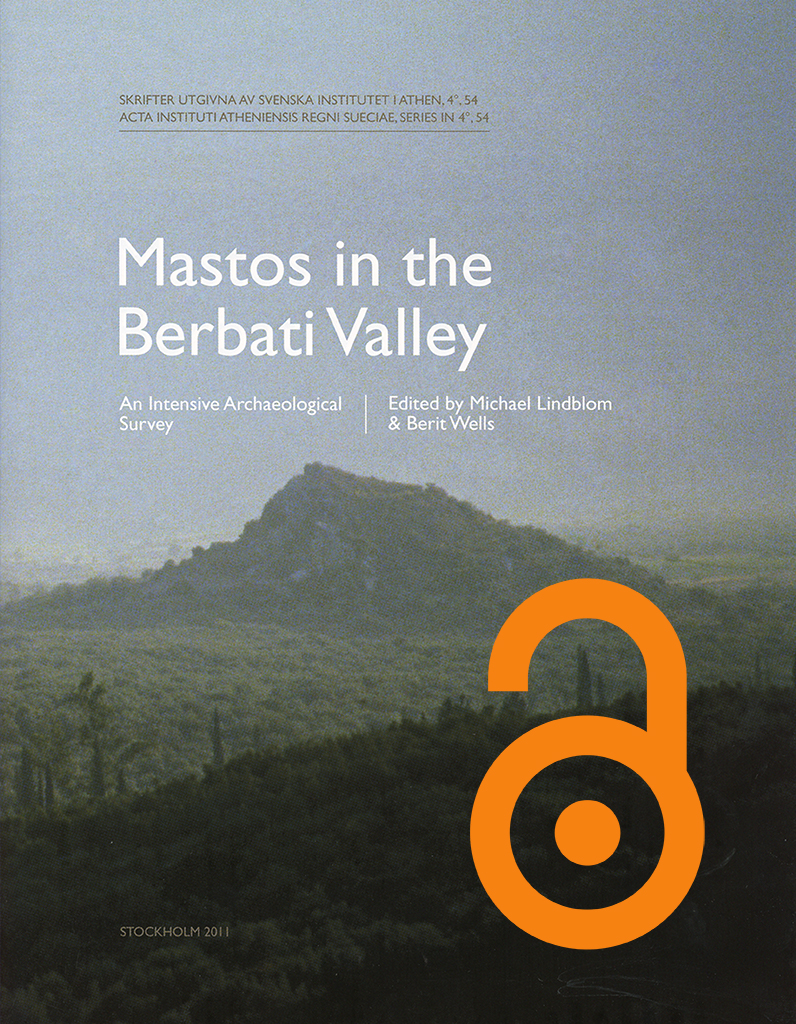
Published by the Swedish Institute at Athens. Distributed by Eddy.se AB. All content is available with open access, use links below. Mastos in the Berbati Valley. An intensive archaeological survey Edited by Michael Lindblom & Berit Wells Abstract This study presents the results of a small but intensive surface survey conducted on the Mastos Hill in the Berbati Valley in 1999. While remains from the Early and Late Helladic period were known from previous excavations on its southern and eastern slopes, this is the first analysis of the entire hill. It includes a digital documentation of the local topography as well as an account of the archaeological remains retrieved in the field. The study fills a gap in different data sets and results gained through old excavations and the extensive 1988–1990 Berbati-Limnes survey. The introductory chapter summarizes previous work in the valley, discusses its ancient routes of communication and outlines the method employed in the archaeological survey. This is followed by an account of the topographical survey and the geographical information system used. In the six following chapters the archaeological remains are presented and analyzed in a diachronic fashion. It is concluded that the hill was predominantely settled in prehistory…
Published by the Swedish Institute of Classical Studies in Rome. Distributed by Astrom Editions. Archaeological investigations in southern Etruria Vol. 1. The Civitella Cesi Survey Bibliographical information Pamela Hemphill, Archaeological investigations in southern Etruria vol. 1. The Civitella Cesi Survey (Skrifter utgivna av Svenska institutet i Rom, 4°, 28), Stockholm 2000. Softcover: 160 pp. ISSN 0081-993X. ISBN 9789170421600.
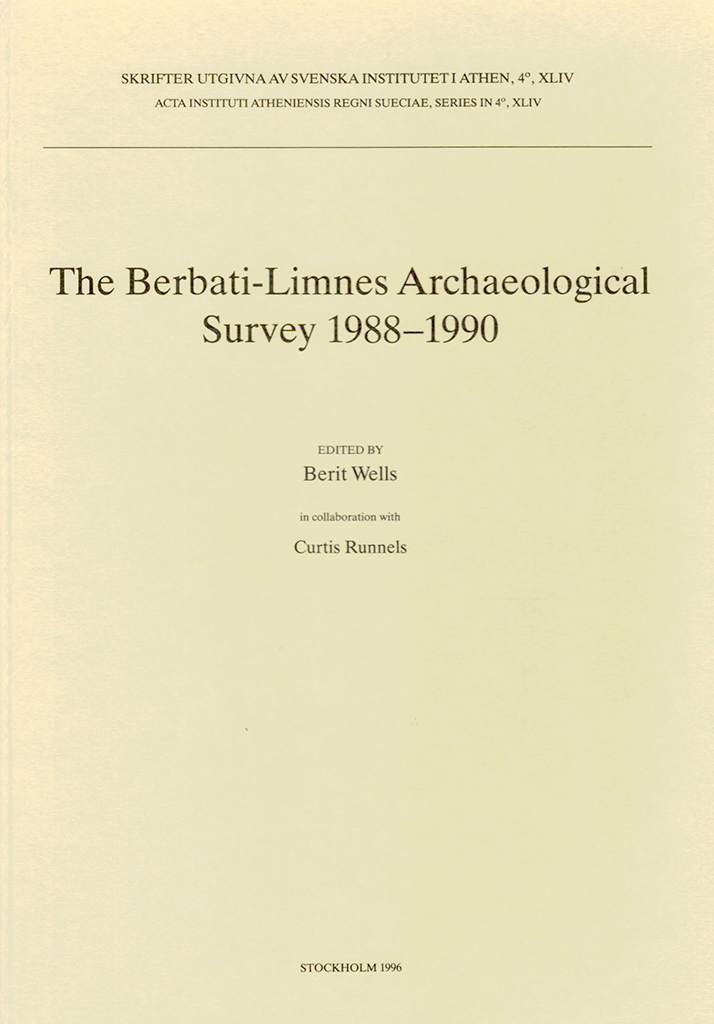
Published by the Swedish Institute at Athens. Distributed by Astrom Editions. The Berbati-Limnes Archaeological Survey 1988–1990 Edited by Berit Wells & Curtis Runnels Abstract This volume presents the results of the surface survey carried out in the Berbati Valley and on the Limnes plateau for three seasons between 1988 and 1990. Both in ancient and modern times the two areas differ considerably both economically and politically, which in part is due to the natural environment, Prosímni (Berbati) lying in a fertile valley and Limnes in a mountainous district. The introductory chapter gives a general background to the project, introducing the two villages involved, presenting the objectives and setting out the methods employed in the field. For much of its history the Berbati-Limnes area depended upon external economic systems and powers. Thus the Final Neolithic–Early Helladic pastoral economy can be explained as part of the developments in the Balkans called the Secondary Products Revolution. These changes resulted in the catastrophic soil erosions which more or less depopulated the area at the end of the EH. The recovery was slow. Only towards the end of Middle Helladic does there seem to be a new beginning, which heralds intensive use of the area…
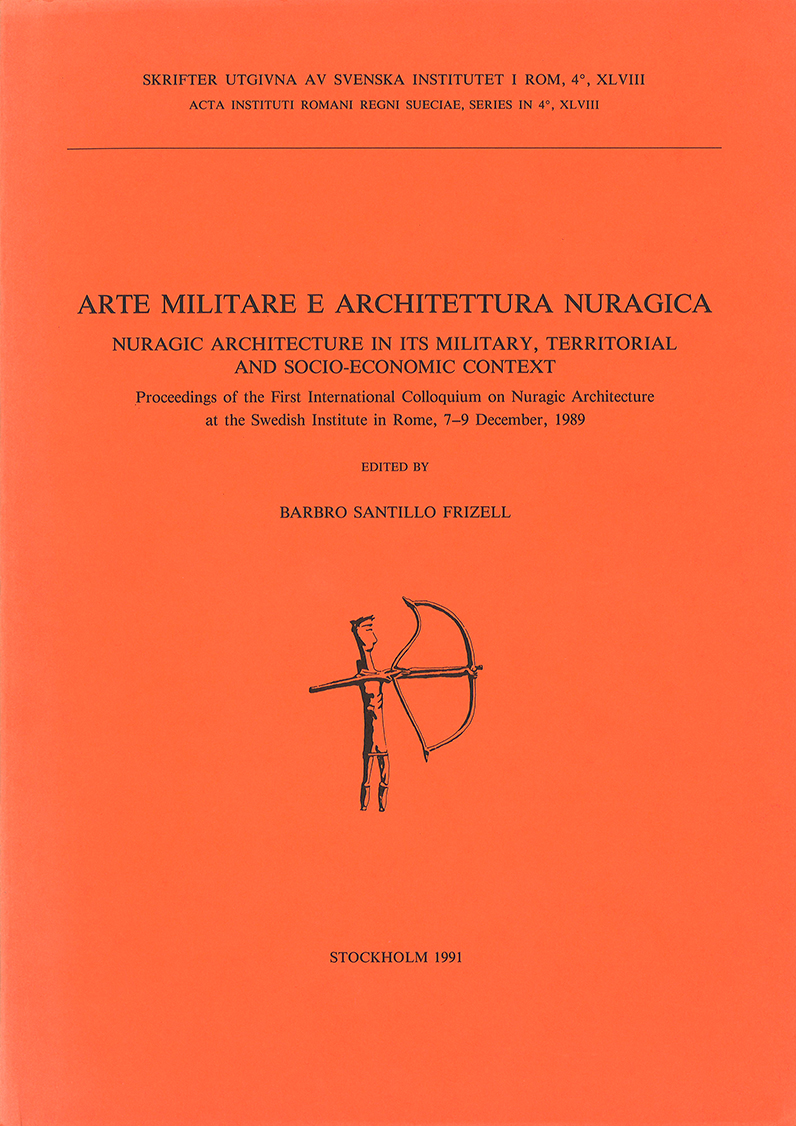
Published by the Swedish Institute of Classical Studies in Rome. Distributed by Astrom Editions. Arte militare e architettura nuragica. Nuragic architecture in its military, territorial and socio-economic context. Proceedings of the First International Colloquium on Nuragic Architecture at the Swedish Institute in Rome, 7–9 December, 1989 Edited by Barbro Santillo Frizell Abstract Twelve papers given at the first international colloquium on the function of the Sardinian nuraghi held at the Swedish Institute in Rome dealing with, in particular, the military function of the nuraghi in relation to tactics and strategy, their territorial distribution and spatial patterning; models for the interpretations of the social and economic development in nuragic society; the social significance of the nuraghi; and the art of warfare from the evidence of related finds. Contents Barbro Santillo Frizell, ‘Introduzione’, 7–12 Barbro Santillo Frizell, ‘Introduction’, 13–18 Miriam Balmuth, ‘Nuragic camouflage’, 19–22 Paola Basoli & Alba Foschi Nieddu, ‘Il sistema insediativo nuragico nel Monte Acuto: analisi preliminare dei fattori geomorfologici e socio-economici’, 23–40 Lucia Manca Demurtas & Sebastiano Demurtas, ‘Analisi dei protonuraghi nella Sardegna centro-occidentale’, 41–52 Stephen L. Dyson & Robert J. Rowland Jr, ‘Continuity and change in Roman rural Sardinia: The Maryland-Wesleyan survey’, 53–63 Leonore Gallini, ‘Architectural evidence for…