Opuscula is published by the Swedish Institutes at Athens and Rome, with the aid of a grant from the Swedish Research Council. Distributed by Eddy.se AB. View journal at ERIH PLUS. All content available with open access at the platform Publicera, hosted by the National Library of Sweden, use links below. Opuscula. Annual of the Swedish Institutes at Athens and Rome 17, 2024 Contents Articles Pergamos. An unexplored fortified site in north-eastern Greece By Patrik Klingborg, Georgia Galani, Jesper Blid, Stavroula Dadaki & Penelope Malama, pp. 7–24, https://doi.org/10.30549/opathrom-17-02 The Palamas Archaeological Project 2023. A preliminary report of the Greek–Swedish collaboration in the municipality of Palamas, region of Karditsa, Thessaly By Maria Vaïopoulou, Robin Rönnlund, Fotini Tsiouka, Johan Klange, Derek Pitman, Ian Randall, Rich Potter & Harry Manley, pp. 25–45, https://doi.org/10.30549/opathrom-17-03 A bronze deposit excavated at Kalaureia in 2016. A statuette of the Herakles Chiaramonti type, a stand and a thymiaterion By Julia Habetzeder, pp. 47–67, https://doi.org/10.30549/opathrom-17-04 A Roman bath with broken windows in Asine, Argolis. The result of repeated earthquakes? By Dominic Ingemark, pp. 69–93, https://doi.org/10.30549/opathrom-17-05 The Tomba Åström and the 1969 excavations at San Giovenale By Mattia D’Acri & Fredrik Tobin-Dodd, pp. 95–111, https://doi.org/10.30549/opathrom-17-06 Architectural terracottas from San Giovenale. Addenda and conclusions By Örjan…
Published by the Swedish Institute at Athens. Distributed by Eddy.se AB. All content is available with open access, use links below. Mastos in the Berbati Valley. An intensive archaeological survey Edited by Michael Lindblom & Berit Wells Abstract This study presents the results of a small but intensive surface survey conducted on the Mastos Hill in the Berbati Valley in 1999. While remains from the Early and Late Helladic period were known from previous excavations on its southern and eastern slopes, this is the first analysis of the entire hill. It includes a digital documentation of the local topography as well as an account of the archaeological remains retrieved in the field. The study fills a gap in different data sets and results gained through old excavations and the extensive 1988–1990 Berbati-Limnes survey. The introductory chapter summarizes previous work in the valley, discusses its ancient routes of communication and outlines the method employed in the archaeological survey. This is followed by an account of the topographical survey and the geographical information system used. In the six following chapters the archaeological remains are presented and analyzed in a diachronic fashion. It is concluded that the hill was predominantely settled in prehistory…
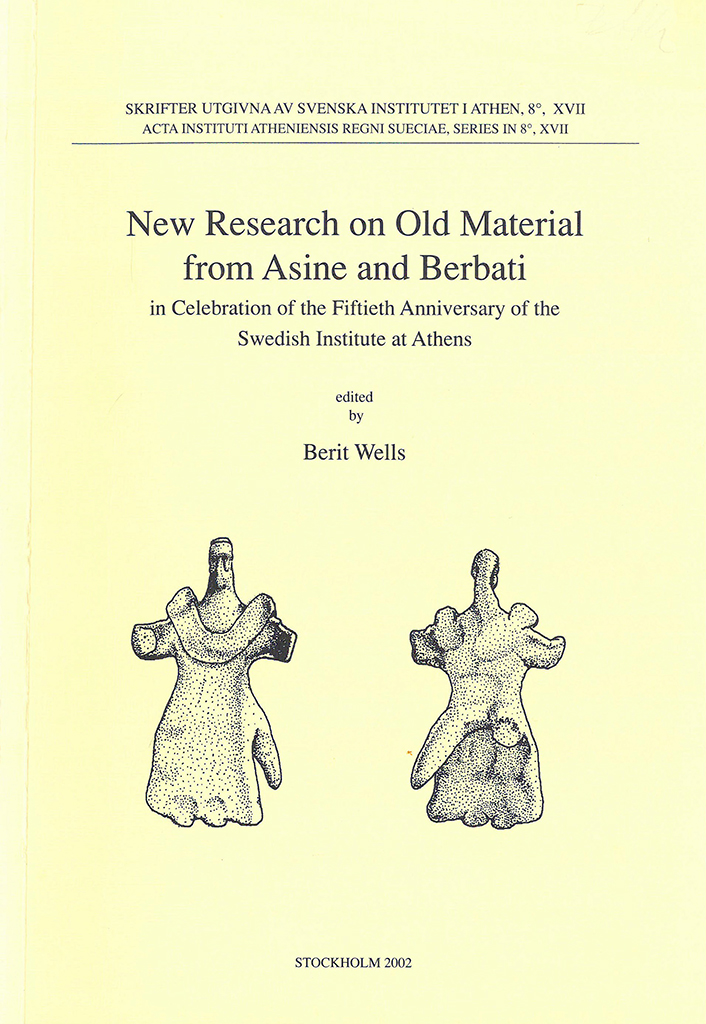
Published by the Swedish Institute at Athens. Distributed by Astrom Editions. New research on old material from Asine and Berbati in celebration of the fiftieth anniversary of the Swedish Institute at Athens Edited by Berit Wells Abstract After an introductory paper on the creation of a Swedish Archaeological School at Athens, ten papers deal with subjects associated with material excavated at Asine and Berbati in the Argolid before the new wave of excavations in the 1970’s. The following subject matters are discussed in relation to Asine: the emergence of an élite in the Middle Helladic (MH) period; pre-firing marks on MH Aeginetan pottery; wooden boxes used as coffins for infants in MH times; MH child morbidity and child mortality; Asine as a case of economic interaction in the Argolid; the provenience and alloy compositions of metal objects diachronically; the source of iron during the Geometric period; bridging the gap in settlement between 700 and 300 BC. Two papers are concerned with Berbati: one underlines the continuity of the Mastos settlement from Early Helladic II into EH III; and one lays out the possibilities for a detailed study of the provenience of the local Mycenaean ceramics. Contents Preface (p. 7) Berit…