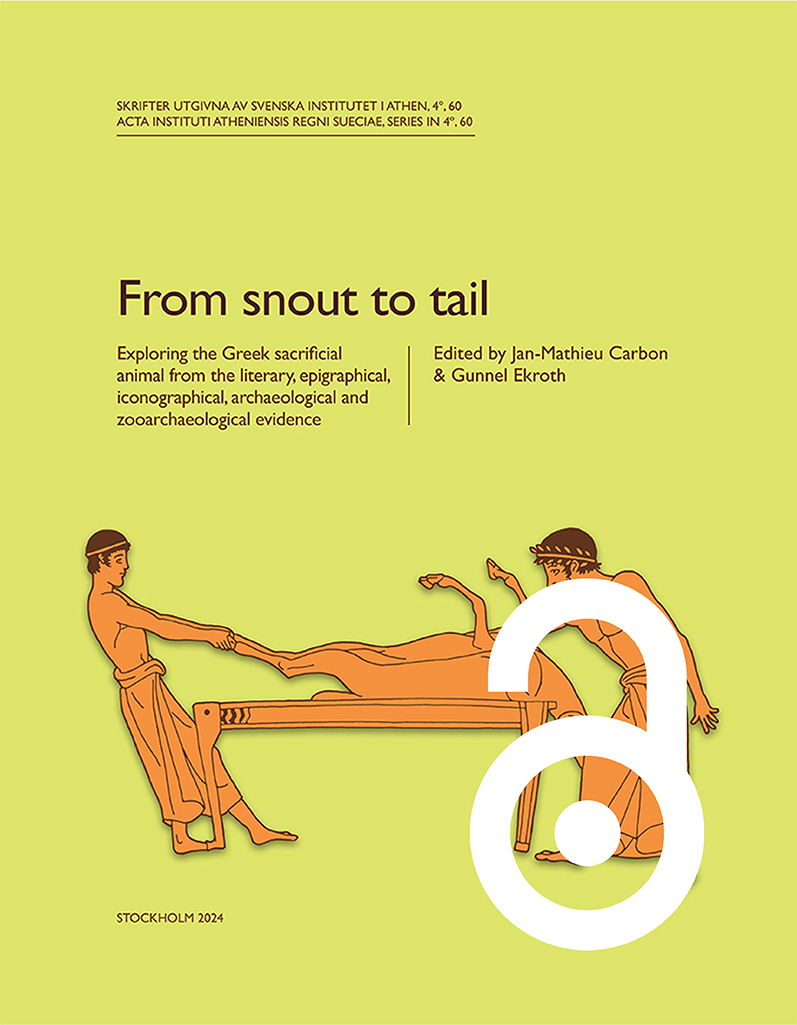
Published by the Swedish Institute at Athens. Distributed by Eddy.se AB. All content is available with open access, use links below. From snout to tail. Exploring the Greek sacrificial animal from the literary, epigraphical, iconographical, archaeological, and zooarchaeological evidence Edited by Jan-Mathieu Carbon & Gunnel Ekroth https://doi.org/10.30549/actaath-4-60 Animal sacrifice fundamentally informed how the ancient Greeks defined themselves, their relation to the divine, and the structure of their society. Adopting an explicitly cross-disciplinary perspective, the present volume explores the practical execution and complex meaning of animal sacrifice within ancient Greek religion (c. 1000 BC–AD 200). The objective is twofold. First, to clarify in detail the use and meaning of body parts of the animal within sacrificial ritual. This involves a comprehensive study of ancient Greek terminology in texts and inscriptions, representations on pottery and reliefs, and animal bones found in sanctuaries. Second, to encourage the use and integration of the full spectrum of ancient evidence in the exploration of Greek sacrificial rituals, which is a prerequisite for understanding the complex use and meaning of Greek animal sacrifice. Twelve contributions by experts on the literary, epigraphical, iconographical, archaeological and zooarchaeological evidence for Greek animal sacrifice explore the treatment of legs, including feet and…