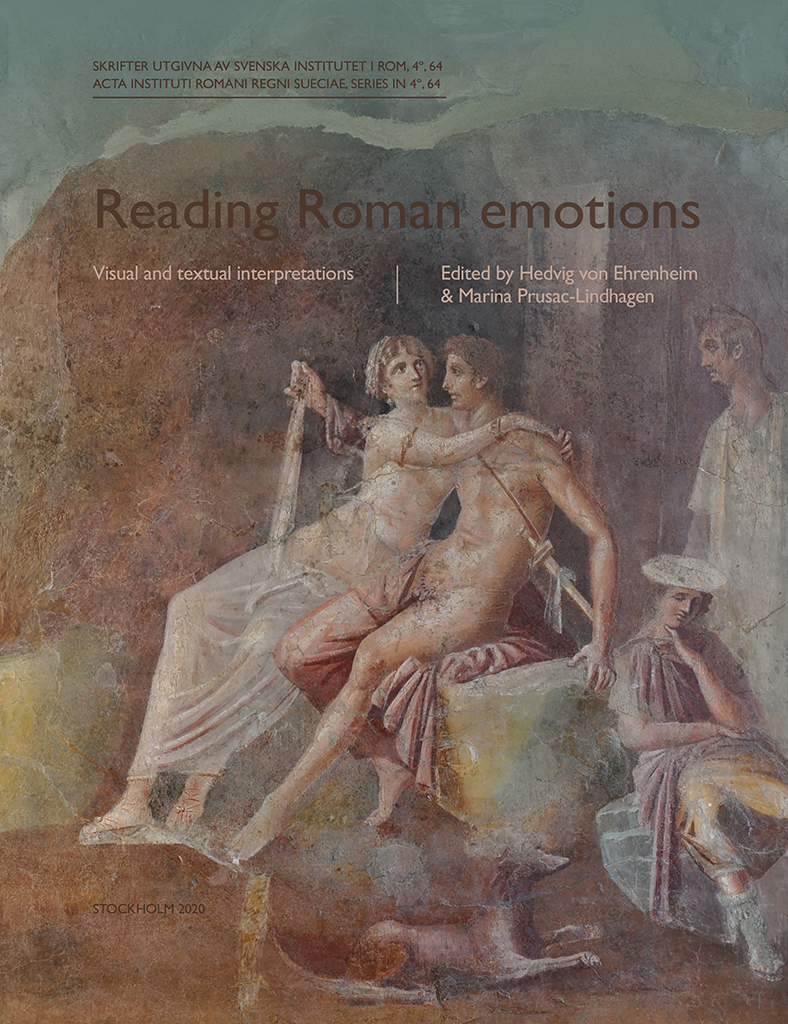
ActaRom-4°, 64: Reading Roman emotions (2020)

Published by the Swedish Institute of Classical Studies in Rome. Distributed by Eddy.se AB. Reading Roman emotions. Visual and textual interpretations Edited by Hedvig von Ehrenheim & Marina Prusac-Lindhagen Abstract This volume is a contribution to the study of culturally bound emotions and emotional response in ancient Rome. Approaches to the study of ancient emotions and how they were culturally specific, appreciated and understood have recently come to the centre of attention, but not so much in the visual as in the literary culture. When socially and affectively contextualized, the material culture of ancient Rome is a potential goldmine of information with regard to emotions. The chapters in the present volume take the reader on a tour through various cases that demonstrate how emotions were expressed through the arts. The tour starts with a fresh view of how emotion history can be used to recover feelings from the visual culture of the past. Visual culture includes animated performances, and the reader is invited to revel in Roman drama, oratory, and love poetry. Words are often clear, but can images reveal laughter and joy, sadness, grief and mourning, virtue and anger? This volume argues that yes, they can, and through the…

Opuscula 6 (2013)
Open Access , Opuscula / 2013-12-01

Opuscula is published by the Swedish Institutes at Athens and Rome, with the aid of a grant from the Swedish Research Council. Distributed by Eddy.se AB. View journal at ERIH PLUS. All content available with open access at the platform Publicera, hosted by the National Library of Sweden, use links below. Opuscula. Annual of the Swedish Institutes at Athens and Rome 6, 2013   Contents Articles The agency of Greek and Roman statues. From Homer to Constantine By Jan N. Bremmer, pp. 7–21, https://doi.org/10.30549/opathrom-06-02   Fragments with horses and wolf’s teeth. Black impasto and its association with periods and buildings in the monumental area at Acquarossa By Margareta Strandberg Olofsson, pp. 23–43, https://doi.org/10.30549/opathrom-06-03   The New Swedish Cyprus Expedition 2012. Excavations at Hala Sultan Tekke. Preliminary results By Peter M. Fischer, Teresa Bürge, I. Trinks, B. Stolle, K. Heiß, J.A.I. van der Does & D.M. Blattner, pp. 45–79, https://doi.org/10.30549/opathrom-06-04   Archaic pottery and terracottas from the Sanctuary of Poseidon at Kalaureia By Alexandra Alexandridou, pp. 81–150, https://doi.org/10.30549/opathrom-06-05   Textual evidence for Aegean Late Bronze Age ritual processions By Jörg Weilhartner, pp. 151–173, https://doi.org/10.30549/opathrom-06-06   A moving story about exotica. Objects’ long-distance production chains and associated identities at Tiryns, Greece By Ann Brysbaert & Melissa Vetters, pp….

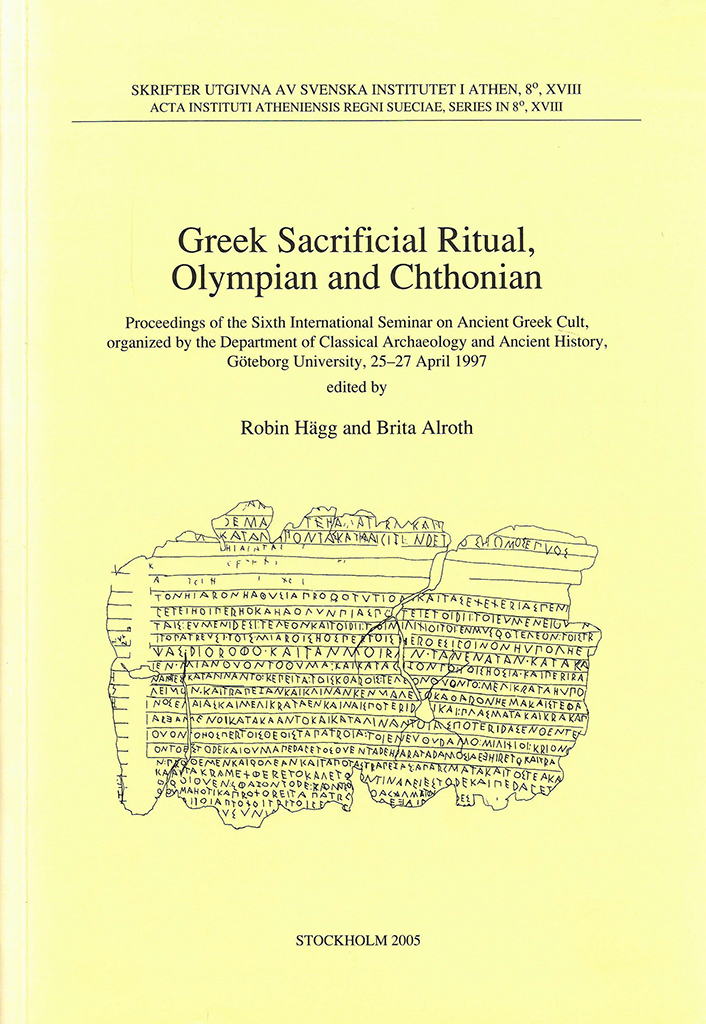
ActaAth-8°, 18: Greek sacrificial ritual, Olympian and chthonian (2005)

Published by the Swedish Institute at Athens. Distributed by Astrom Editions. Greek sacrificial ritual, Olympian and Chthonian. Proceedings of the Sixth International Seminar on Ancient Greek Cult, organized by the Department of Classical Archaeology and Ancient History, Göteborg University, 25–27 April 1997 Edited by Robin Hägg & Brita Alroth Abstract A collection of eighteen papers, read or circulated at an international seminar in Göteborg, that deal with the ancient Greek sacrificial ritual, with special reference to the traditional dichotomy between the Olympian and the chthonian aspect, the relevance of which has been questioned in modern research. Among the special topics discussed are sacrifices to heroes and in the cult of the dead, magical sacrifice, sacrifice to the sea, pig sacrifice and the sacrifice of pregnant animals. Other aspects dealt with include the role of dedications in the cult and the practicalities of ruler-cult, as well as the priest’s role in Greek sacrifice. Several contributions discuss the implications of the recently published lex sacra from Selinous for the understanding of Greek sacrificial practice, reinterpreting previously known inscriptions in the light of the new evidence. Two papers deal with descriptions of sacrifice in Greek tragedy (Aeschylus, Oresteia; Sophocles, Trachiniae). There is a…

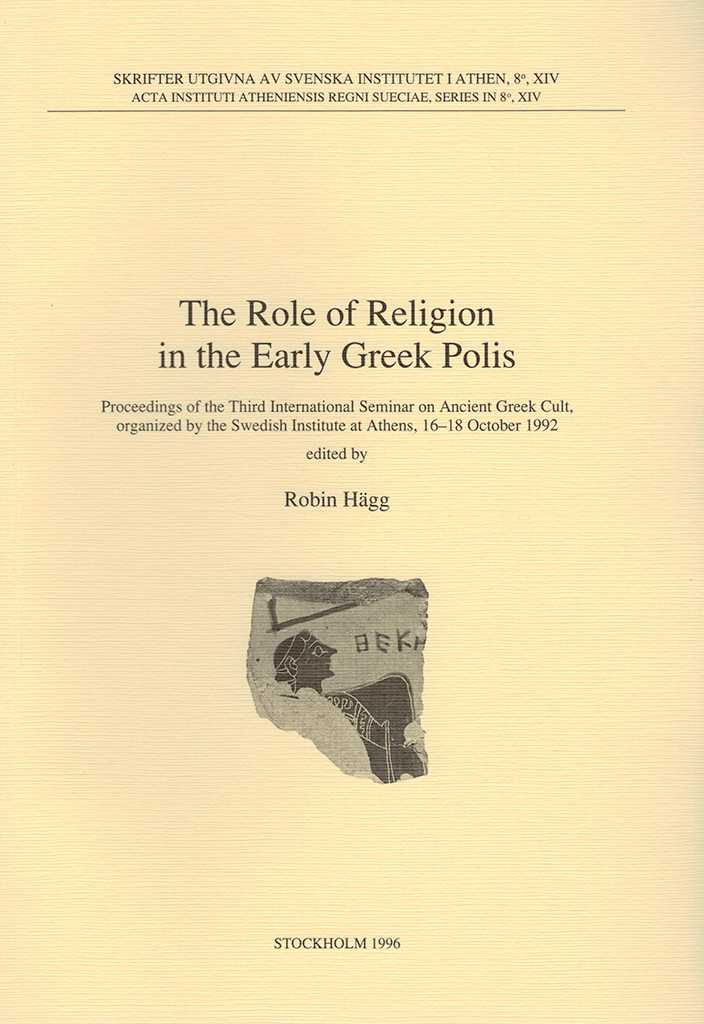
ActaAth-8°, 14: The role of religion in the early Greek polis (1996)

Published by the Swedish Institute at Athens. Distributed by Astrom Editions. The role of religion in the early Greek polis. Proceedings of the Third International Seminar on Ancient Greek Cult, organized by the Swedish Institute at Athens, 16–18 October 1992 Edited by Robin Hägg Abstract These twelve papers read at an international seminar in Athens deal with various aspects of the role of religion in the early Greek polis, based on the epigraphical, iconographical and archaeological evidence. Among the special topics discussed are territorial myths and the mythical articulations with regard to the early polis, the Greek temple-builders, the distribution of offerings and rituals between graves and sanctuaries, the development of sacred and profane civic ideology in Athens, processions (pompai), verbal and ritual obscenity in women’s cults, prohibitionary inscriptions, the role of the seer, the Thesmophorion in central Athens, the cults in Solonian Athens, cults by the seashore and Dionysos at Argos. Contents ‘Preface’, p. 7 Irad Malkin, ‘The polis between myths of land and territory’, pp. 9–19 Walter Burkert, ‘Greek temple builders: who, where and why?’, pp. 21–29 François de Polignac, ‘Entre les dieux et les morts. Statut individual et rites collectifs dans la cite archaïque’, pp. 31–40 Sanne…