ActaAth-4°, 59: The stuff of the gods (2024)

Published by the Swedish Institute at Athens. Distributed by Eddy.se AB. All content is available with open access, use links below. The stuff of the gods. The material aspects of religion in ancient Greece Edited by Matthew Haysom, Maria Mili & Jenny Wallensten https://doi.org/10.30549/actaath-4-59 The “material turn” in the humanities and social sciences has brought about an expanded understanding of the material dimension of all cultural and social phenomena. In the Classics it has resulted in the breaking down of boundaries within the discipline and a growing interest in materiality within literature. In the study of religion cross-culturally new perspectives are emphasising religion as a material phenomenon and belief as a practice founded in the material world. This volume brings together experts in all aspects of Greek religion to consider its material dimensions. Chapters cover both themes traditionally approached by archaeologists, such as dedications and sacred space, and themes traditionally approached by philologists, such as the role of objects in divine power. They include a wide variety of themes ranging from the imminent material experience of religion for ancient Greek worshippers to the role of material culture in change and continuity over the long term. Chapter abstracts and author affiliations…
ActaRom-4°, 64: Reading Roman emotions (2020)

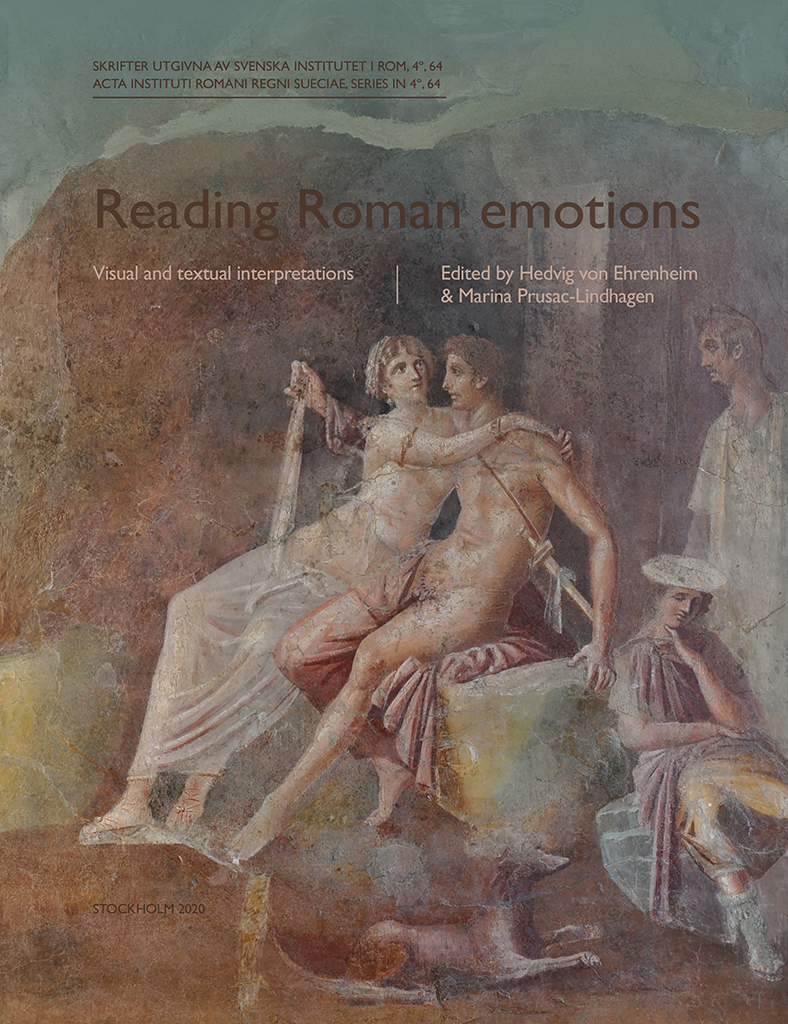
Published by the Swedish Institute of Classical Studies in Rome. Distributed by Eddy.se AB. Reading Roman emotions. Visual and textual interpretations Edited by Hedvig von Ehrenheim & Marina Prusac-Lindhagen Abstract This volume is a contribution to the study of culturally bound emotions and emotional response in ancient Rome. Approaches to the study of ancient emotions and how they were culturally specific, appreciated and understood have recently come to the centre of attention, but not so much in the visual as in the literary culture. When socially and affectively contextualized, the material culture of ancient Rome is a potential goldmine of information with regard to emotions. The chapters in the present volume take the reader on a tour through various cases that demonstrate how emotions were expressed through the arts. The tour starts with a fresh view of how emotion history can be used to recover feelings from the visual culture of the past. Visual culture includes animated performances, and the reader is invited to revel in Roman drama, oratory, and love poetry. Words are often clear, but can images reveal laughter and joy, sadness, grief and mourning, virtue and anger? This volume argues that yes, they can, and through the…

Opuscula 11 (2018)
Open Access , Opuscula / 2018-11-08

Opuscula is published by the Swedish Institutes at Athens and Rome, with the aid of a grant from the Swedish Research Council. Distributed by Eddy.se AB. View journal at ERIH PLUS. All content available with open access at the platform Publicera, hosted by the National Library of Sweden, use links below. Opuscula. Annual of the Swedish Institutes at Athens and Rome 11, 2018   Contents Articles Preliminary report of the Malthi Archaeological Project, 2015–2016 By Rebecca Worsham, Michael Lindblom & Claire Zikidi, pp. 7-27, https://doi.org/10.30549/opathrom-11-02   The New Swedish Cyprus Expedition 2017: Excavations at Hala Sultan Tekke (The Söderberg Expedition). Preliminary results. By Peter M. Fischer & Teresa Bürge, with contributions by M. Ausiayevich, B. Placiente Robedizo, V. Barrera Alarcón, L. Recht & D. Kofel, pp. 30-79, https://doi.org/10.30549/opathrom-11-03   Two Early Helladic II terracotta rollers from Asine and their glyptic context By Michael Lindblom, Gullög Nordquist & Hans Mommsen, pp. 81-96, https://doi.org/10.30549/opathrom-11-04   Tokens of piety. Inexpensive dedications as functional and symbolic objects By Gina Salapata, pp. 97-109, https://doi.org/10.30549/opathrom-11-05   The use of miniature pottery in Archaic–Hellenistic Greek sanctuaries. Considerations on terminology and ritual practice By Signe Barfoed, pp. 111-126, https://doi.org/10.30549/opathrom-11-06   Painting early death. Deceased maidens on funerary vases in the National Archaeological Museum…

Opuscula 10 (2017)
Open Access , Opuscula / 2017-12-01

Opuscula is published by the Swedish Institutes at Athens and Rome, with the aid of a grant from the Swedish Research Council. Distributed by Eddy.se AB. View journal at ERIH PLUS. All content available with open access at the platform Publicera, hosted by the National Library of Sweden, use links below. Opuscula. Annual of the Swedish Institutes at Athens and Rome 10, 2017   Contents Articles Clay paste characterization and provenance determination of Middle and Late Helladic vessels from Midea By Katie Demakopoulou, Nicoletta Divari-Valakou, Joseph Maran, Hans Mommsen, Susanne Prillwitz & Gisela Walberg, pp. 7–49, https://doi.org/10.30549/opathrom-10-02   The New Swedish Cyprus Expedition 2016. Excavations at Hala Sultan Tekke (The Söderberg Expedition). Preliminary results By Peter M. Fischer, Teresa Bürge, Laerke Recht, Dominika Kofel, David Kaniewski, Nick Marriner & Christophe Morhange, pp. 50–93, https://doi.org/10.30549/opathrom-10-03   Power and coinage. The portrait tetradrachms of Eumenes II By Marie-Christine Marcellesi, pp. 94–106, https://doi.org/10.30549/opathrom-10-04   The stadion of Labraunda By Paavo Roos, pp. 107–127, https://doi.org/10.30549/opathrom-10-05   Symbolic connotations of animals at early Middle Helladic Asine. A comparative study of the animal bones from settlement and its graves By Stella Macheridis, pp. 128–152, https://doi.org/10.30549/opathrom-10-06   The lower city of Asea, Arcadia. Results from a geophysical project 2001–2012 By Jeannette Forsén,…

ActaRom-4°, 61: San Lorenzo in Lucina (2012)
ActaRom-4° / 2012-01-01

Published by the Swedish Institute of Classical Studies in Rome. Distributed by Eddy.se AB. San Lorenzo in Lucina. The transformations of a Roman quarter Edited by Olof Brandt Abstract This volume presents the results of research carried out by the Swedish Institute in Rome in the Roman church of San Lorenzo in Lucina. This research involved the Roman phases of the site and the surrounding quarter. The research began with the 1993–1998 excavation of the baptistery of the Early Christian church, and continued in 2000 with a project which also included other parts, aspects and periods of the site. The papers in this volume shed new light on the Late Roman and post-Antique development of an area which is between Augustan monuments such as the Ara Pacis, the Mausoleum of Augustus, the obelisk and its meridian. The papers include studies on the early 3rd century insula beneath the church, the baptistery and the Early Christian basilica, as well a survey of hagiographic legends, medieval wall-paintings, and other finds such as inscriptions and graffiti, pottery, glass, marble, bones and spolia. Reports on the conservation on fragments of Roman wall-paintings and marble fragments are also included. Contents Barbro Santillo Frizell, ‘Preface’ Olof…