Opuscula 19:2: The Swedish Institute of Classical Studies in Rome, 1926–2026 (2026)
Open Access , Opuscula / 2026-11-19

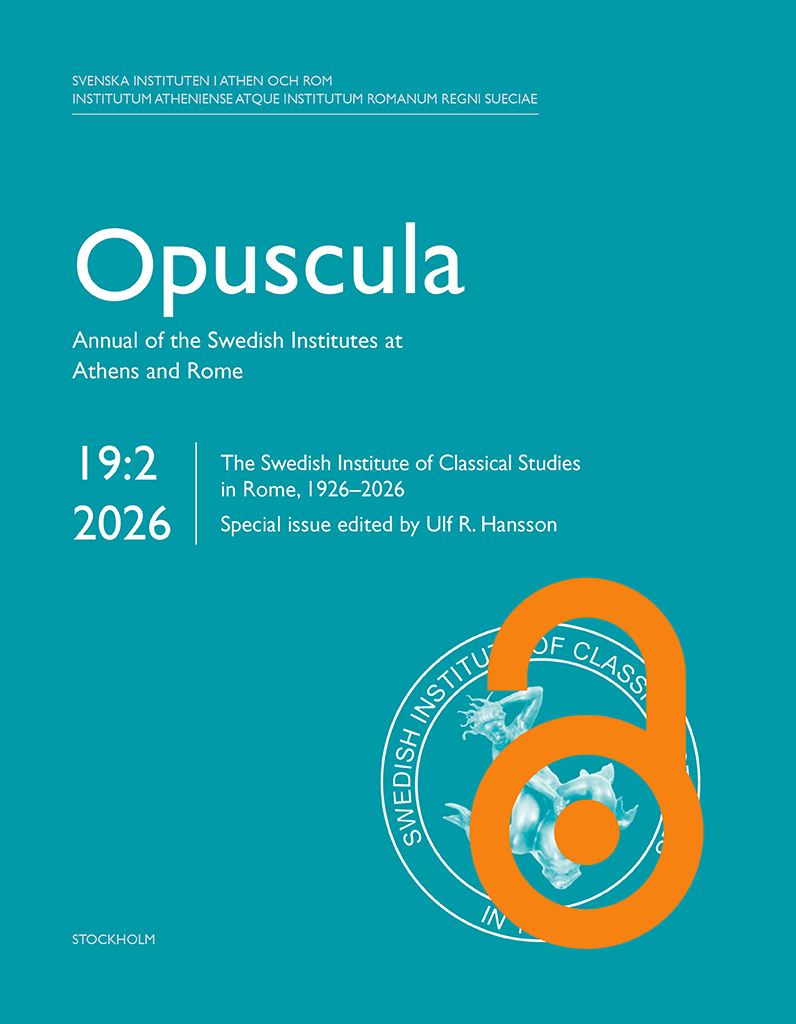
Opuscula is published by the Swedish Institutes at Athens and Rome, with the aid of a grant from the Swedish Research Council. Distributed by Eddy.se AB. View journal at ERIH PLUS. All content available with open access at the platform Publicera, hosted by the National Library of Sweden, use links below. Opuscula. Annual of the Swedish Institutes at Athens and Rome 19:2, 2026   The Swedish Institute of Classical Studies in Rome, 1926–2026 Special issue edited by Ulf R. Hansson A hundred years have passed since Axel Boëthius (1889–1969, director 1926–1935, 1952–1953, 1955–1957) for the very first time—and, one likes to imagine, full of anticipation—opened the doors to the apartment at no. 68 Via del Boschetto, from which the Swedish Institute of Classical Studies in Rome was to operate during its earliest formative years. The official inauguration took place on Monday, 1 February 1926. That same spring, Boëthius welcomed the first group of students to the Institute’s archaeological course, which it has been offering annually—with very few exceptions—ever since, fostering generations of Swedish archaeologists and classicists who over the decades have contributed to making the Institute the vibrant centre for research, collaboration and exchange that it is today. What better way to celebrate the centenary…

ActaRom-4°, 58: Dionysos in Etruria (2005)
ActaRom-4° / 2005-01-01

Published by the Swedish Institute of Classical Studies in Rome. Distributed by Astrom Editions. Dionysos in Etruria. The Ivy Leaf Group By Ingrid Werner, with an introduction by F.R. Serra Ridgway Bibliographical information Ingrid Werner, Dionysos in Etruria. The Ivy Leaf Group (Skrifter utgivna av Svenska institutet i Rom, 4°, 58), Stockholm 2005. Softcover: 118 pp. ISSN 0081-993X. ISBN 9789170421709.

ActaRom-4°, 43: The gods and the place (1987)
ActaRom-4° / 1987-01-01

Published by the Swedish Institute of Classical Studies in Rome. Out of print. The gods and the place. Location and function of sanctuaries in the countryside of Etruria and Magna Graecia (700–400 B.C.) By Ingrid Edlund Abstract This study presents the archaeological evidence for the many different places of worship used by the Etruscans and Greeks in ancient Italy. Common to both cultures was the tradition of sacred places in nature such as mountains, caves, groves, and springs which had often been in use since prehistoric times. Other types of sanctuaries reflect the development of the urban settlements in contrast to the rural life of the countryside. A main distinction is made between the temples and other sanctuaries which were extra-mural and located in direct proximity to the city or extra-urban and located in the countryside but controlled by the city, and the rural sanctuaries which served the needs of the rural population. Because of the differences in the settlement history of Etruria and Magna Graecia, the Etruscan sanctuaries were for the most part extra-mural or extra-urban, whereas the Greek colonies and their rural territories give examples of a variety of extra-mural, extra-urban, and rural sanctuaries. Peculiar to the Etruscan…